

Why Are Christening Gowns Long? From Swaddling to the Waterfall Frame
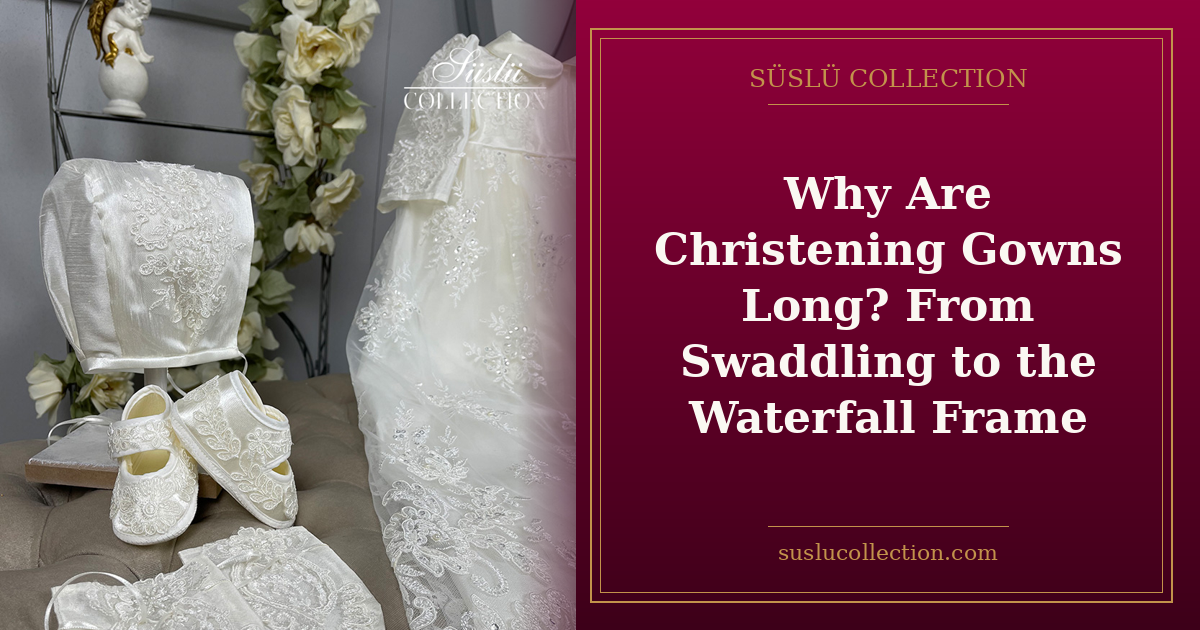
Why is a christening gown longer than the baby? Short answer: length is history and symbol, not decoration — the hem of a story running from unwound swaddling to the Victorian showcase. 📜
This guide tells the story in four steps, builds the symbol-versus-practice scale, and closes “how long for our baby?” with five measures.
By the end, length stops being a measurement question and becomes a conscious choice. ✨
Master guide: the christening outfit guide · meaning’s other half: why white.
From swaddling to gown: four steps of length
The strip gave four steps; this section explains why each happened. The long hem’s origin surprises: the story begins not with fashion but with the abandonment of swaddling. 🍼
This origin grants a practical comfort: length was never an obligation in any era — always a meaningful choice.
What did babies wear in the swaddling age?
Wrap, not clothing: babies stayed swaddled for months, with a cover added for ceremonies. The chrisom cloth belonged to that world — its white side lives in the white article.
What happened when swaddling unwound?
The baby’s body met clothing for the first time: the 18th century’s long, loose garments left room for growth and eased carrying. Length was practical from day one.
Why did the Victorians exaggerate it?
The showcase effect: layered, lace-heavy hems past arm’s length displayed a family’s gratitude and means. Royal gowns are that era’s inheritance — the story continues in royal traditions.
What does length carry today?
The symbol: the hem flowing in the lap remained the blessing’s visual signature. Practical short models joined it; both live inside the tradition.
History placed. Now the scale: symbol or practice? ⚖️
The symbol-practice scale: an honest weighing
The table sets two voices against each other; both are right, and the scale turns on the baby’s age. In the lap window the symbol is free: the long hem charges no practical price. 🎭
The price begins with movement: hems tangle around crawling feet — and the symbol need not be sold for comfort; it is simply shortened.
Why is the long hem free in the lap age?
Because the baby is carried anyway: the hem never touches ground, never tangles — it only flows. The waterfall photograph is this age’s unconditional gift.
Is the long hem a problem at the font?
Manageable: in the undershirt-first order the gown waits for after the water; in the dressed order the hem gathers over the arm. Both routines are in the dressing guide.
Does a short model kill the symbol?
No — the symbol spreads across tone and rite: white base, bonnet, shawl and the blessing itself stand untouched. A short hem gives up only the waterfall frame; nothing else.
What if grandparents expect long?
A middle path exists: knee-length hem plus a long shawl satisfies both movement and expectation. The full model map is in the model guide.
Scale balanced. Next: the decision in measures — five of them. 📏
Five measures for the length decision
The list ordered the measures; this section resolves the border cases. Age is the main axis; album language and ceremony rhythm perform fine-tuning. 🎯
The tie rule: when age wants shorter and the album wants longer, age wins — comfort is the precondition of every frame.
Why is 9-14 months the grey zone?
Because the baby lives in two modes daily: calm in the lap, explorer on the floor. Knee-length solves the duality in one model; hybrid romper-gowns are the same zone’s invention.
How does a long rite make length comfortable?
By the blanket effect: in a stone building’s chill, the long hem wraps the legs naturally. Winter ceremonies weigh this heavily — the season side is in the season guide.
How does the size table state length?
Separately: gown hem is its own number beyond body size — “body 68, hem 85”. Measuring technique is in the sizing guide; the overshoot is the album’s choice.
Still stuck between two?
The photo vote: place two models’ product frames side by side and ask which you want in the album. If the tie holds, write to contact — we listen to your ceremony rhythm and answer in one sentence.
Decision made. Closing: the long hem’s heirloom privilege. 🎀
The long hem’s privilege: queen of the heirloom road
The long gown has an under-discussed advantage: it is the best-inheriting model. The reason is not sentimental but technical. 📦
Three technical reasons: loose cut, overshooting hem, lace surface — all three ease the fit for the next owner.
Why is the loose cut heirloom-friendly?
Because size tolerance is wide: sibling, cousin, grandchild — different babies fit the same gown. Short, fitted cuts cannot offer that stretch.
What does the overshooting hem buy?
Time tolerance: since the hem flows independent of the baby’s height, “too big” becomes invisible. Heirloom fittings often pass without alteration.
Does lace welcome repair?
It does: a worn panel can be replaced, a missing motif completed. The workshop’s heirloom services are in the custom guide; storage discipline in the storage guide.
Building an heirloom from today?
Long gown + date embroidery + acid-free box: the trio opens the family register’s first page. Candidates stand flagged “heirloom-friendly” in the collection.
The length file closes: history, scale, measures, inheritance. Summary below. 🕊️
🧵 Notes from the Workshop
The sweetest objection we hear: “isn’t it strange that it’s longer than the baby?” — at the lap fitting, the first time the hem flows, the sentence is withdrawn with the same smile every time. Second note: the knee-length middle path is the quiet hero reconciling grandmother expectations with modern practicality — rising demand season after season. Third: heirloom gowns arriving at the workshop fit their new babies mostly without alteration thanks to the overshooting hem — Victorian excess returns to the grandchildren as pragmatism.
📖 Quick Glossary
Swaddling: the tradition of wrapping babies in bands. Waterfall fall: the flowing-hem lap image. Overshooting hem: the skirt exceeding the baby’s height. Grey zone: the 9-14 month length dilemma. Heirloom-friendly: the flag for inheritance-ready cuts.
⚡ Quick Summary
The long hem was born when swaddling unwound, grew in the Victorian showcase, and lives today as symbol. 📜 In the lap window (0-9 months) length is free — the waterfall frame comes without cost; crawling hands the stage to knee-length and short models. Five measures decide, with age as the main axis and every tie broken by age. The long gown is also the heirloom road’s queen: loose cut, overshooting hem, repairable lace.
🎯 Next Step
Write the baby’s age and your ceremony rhythm via contact — the length verdict in one sentence; long, knee and short hems wait on separate shelves in the collection.
Sıkça Sorulan Sorular
Why are christening gowns longer than the baby?
Length descends from the first loose garments born when swaddling was abandoned, and grew into a showcase in the Victorian era. Today the hem flowing in the lap survives as the blessing’s visual symbol.
Is a long christening gown practical?
Entirely so in the lap age (0-9 months): the baby is carried, so the hem never tangles — it only flows. Once crawling begins, knee-length or short models take over; in long rites the hem even doubles as a leg blanket.
How do you choose a christening gown’s length?
Age is the main axis: lap age takes full length, 9-14 months knee-length, walking age short models. The album fine-tunes; when age wants shorter and the album wants longer, age wins.
Kaynak: Wikipedia — Swaddling
Christening
Browse Products


