

Custom Christening Outfit: Six Stations from Brief to Box
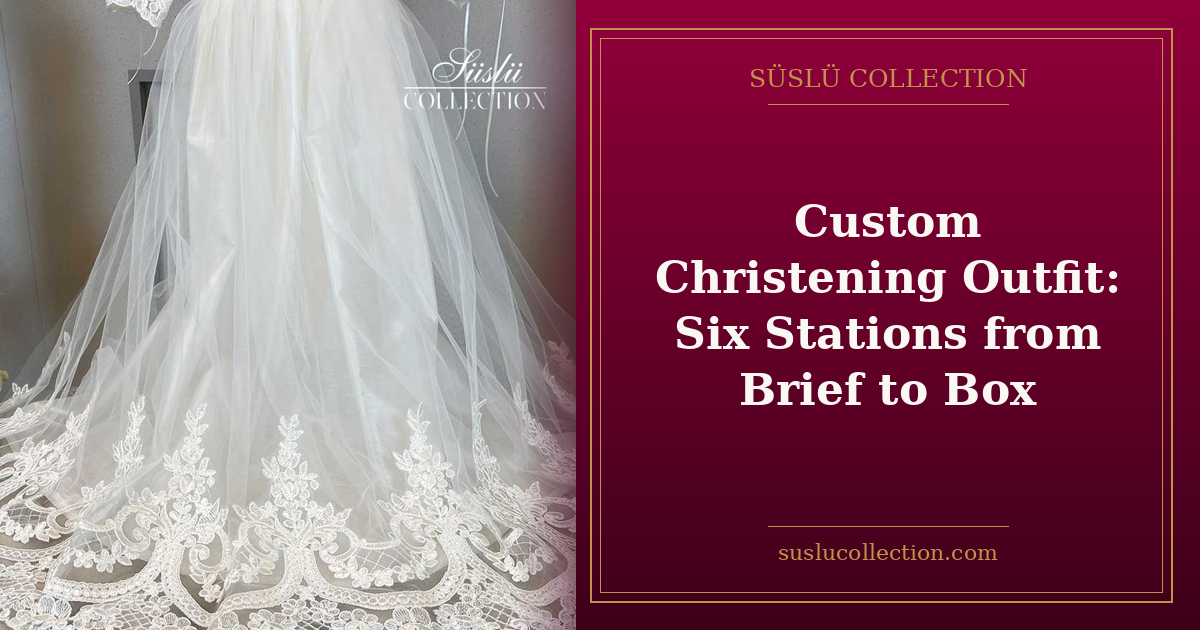
How does a custom christening outfit come to life? The short answer: through six approved stations — brief, proposal, materials, sewing, fitting, delivery — each moving only on your yes. 🧵
This guide walks the six stations, draws the honest lane between ready-made and custom, and lists exactly what can be personalised.
The promise of custom is not speed but precision with meaning: your baby’s numbers, your family’s names, sewn in. ✨
Master guide: the christening outfit guide · timeline bands: when to prepare.
Six stations, six approvals
The strip maps the journey; this section explains why every station waits for you. The approval rhythm is the custom lane’s safety system: no surprise ever travels more than one station. 🚉
Total journey: four to five weeks from brief to box, aimed — as always — at delivery one week before the ceremony.
What makes a strong brief?
Four ingredients: the ceremony date, three measurements, the model wish, and the personal touches. Measuring technique is in the sizing guide; the model families in the model guide.
What does the proposal contain?
The whole plan in one message: sketch or product reference, fabric and lace plan, price, station dates. You approve the plan, not a hope.
Why approve fabric before sewing?
Because tone and texture live in real material: a photographed sample — or a posted swatch — in daylight beats every description. The snow-or-ecru decision happens here, by the tone rules.
What is the fitting check?
The real garment on camera in natural light — or on the baby, for local families: your final yes before the box closes.
Stations mapped. Now the honest question: is custom for you? ⚖️
Ready-made or custom: choosing your lane
The table draws two honest lanes; this section reads the signs. The lanes are not rivals — they serve different briefs — and most families genuinely belong to the ready-made lane. 🛣️
The custom lane earns its weeks in three cases: personalisation woven in, non-standard sizes, heirloom ambitions.
When is ready-made simply right?
Standard size, standard timeline, love at first product photo: the stock gown with a matching set closes the brief in days. The buying checks are in where to buy.
What pulls a family into the custom lane?
The embroidery, usually: a name and date inside the hem turns a gown into a record. Add unusual measurements and the heirloom trio — loose cut, natural fibre, repairable lace — and custom becomes the practical answer.
Can the lanes be mixed?
Often: a stock gown plus custom embroidery is the popular middle path — ready-made speed, personalised meaning. Ask via contact; the add-on window is real but shorter.
What does the busy season change?
Both lanes shift a week earlier in spring-summer — custom feels it first, because stations cannot be compressed. The season calendar is in the timeline guide.
Lane chosen. Next: what exactly the needle can write. ✍️
The personalisation menu, item by item
The list opens the menu; this section tastes each item. The house rule over all of them: personalisation deepens the outfit’s story and never breaks the white base or the symbol dose. 📖
Every item is quoted inside the proposal — no station-three surprises.
Where does the name embroidery live?
Inside the hem, invisible outside: the gown stays classic, the record stays private. Each future christening adds a line below — the family register logic borrowed from Scandinavian tradition.
How is the lace motif chosen?
From the pattern book: rose, cross, vine — each photographed on real fabric. Motifs carry their own history, told in the history article.
What is in the heirloom package?
The trio plus the box: loose cut, repairable lace panels, and acid-free storage from day one. It is the fifty-year decision made at the start — the payoff routine is in the storage guide.
Can godparents commission the outfit?
Warmly — several traditions expect it: we run the three-way thread (family, godparent, workshop) so sizes and surprises both survive.
Menu closed. Last chapter: the calendar that makes it all real. 🗓️
The custom calendar and the honest edges
Custom lives or dies on the calendar; this closing chapter fixes the bands and names the honest edges — what we decline, and why declining protects you. ⏳
The band: brief at 4-5 weeks out, delivery at one week out. Between them, the stations breathe.
Why can stations not be compressed?
Because each waits on real things: fabric arriving, lace setting, your approvals landing. Rushed sewing buys speed with precision — the one trade a christening gown cannot afford.
What happens if a station slips?
The plan absorbs it: the one-week-early delivery target is the buffer, and you hear about any slip the day it happens — with the recovery plan in the same message.
What do we honestly decline?
Two-week custom briefs in peak season, and last-minute embroidery on delivery week: saying no early beats failing late. The rescue lane for tight timelines is ready-made — honestly signposted in where to buy.
How does the journey begin today?
One message: date, three measurements, model wish, personal touches to contact — the proposal returns with stations dated; reference models to point at wait in the collection.
The custom file closes: stations, lanes, menu, calendar. Summary below. 🎀
🧵 Notes from the Workshop
The station families praise most is the fabric approval: holding the daylight photo of their actual lace, the abstract order becomes their gown — trust is built at station three. Second note: the stock-gown-plus-embroidery middle path is our fastest-growing order type; meaning without the full timeline. Third: every decline we send for impossible timelines earns a thank-you later — “you were the only ones who said it straight” is the sentence that built this lane’s reputation.
📖 Quick Glossary
Brief: the opening message — date, numbers, wishes. Station: an approval-gated production step. Swatch: the real fabric sample for tone approval. Heirloom package: loose cut, repairable lace, acid-free box. Middle path: stock gown with custom embroidery.
⚡ Quick Summary
Custom runs through six approved stations — brief, proposal, fabric approval, sewing, fitting, delivery — in a 4-5 week band aimed at the one-week-early box. 🧵 The lane earns its weeks for woven-in embroidery, non-standard sizes and heirloom briefs; most families are honestly served by ready-made, and the stock-plus-embroidery middle path serves both. The menu: hem-inside name and date, motif choice, tone matching, the heirloom package, set engraving.
🎯 Next Step
Open your brief today: date, three measurements, model wish and touches via contact — the dated proposal returns the same day; reference models wait in the collection.
Sıkça Sorulan Sorular
How does a custom christening outfit process work?
Through six approval-gated stations: your brief (date, measurements, wishes), a dated proposal, fabric and lace approval on real samples, sewing, a fitting or photo check, and delivery one week before the ceremony. The whole band runs four to five weeks.
When is custom worth it over ready-made?
In three cases: name-and-date embroidery woven in, non-standard sizes, and heirloom ambitions (loose cut, repairable lace, acid-free box). For standard sizes and timelines, ready-made — or a stock gown with added embroidery — serves honestly.
What can be personalised on a christening gown?
Name and date embroidered inside the hem, lace motif choice from the pattern book, snow-or-ecru tone matched on a sample, the heirloom package, and set engraving — ribbon date, bonnet initial, shawl corner motif.
Kaynak: Wikipedia — Bespoke tailoring
Christening
Browse Products


