

Why Are Christening Gowns White? A Sign’s Two-Thousand-Year Journey
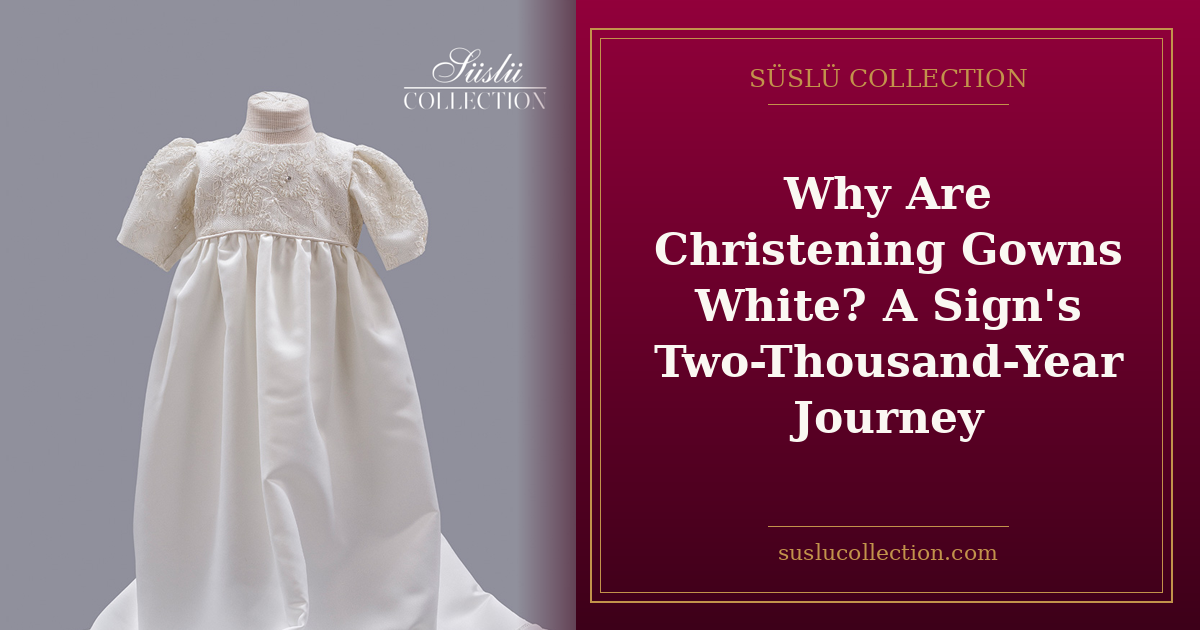
Why are christening gowns white? One sentence: white is the wearable form of the purity that baptism promises — a two-thousand-year sign in today’s fabric. 🤍
This guide walks the sign’s four-stop journey, ties the snow-or-ecru choice to skin tone and light, and closes the “how much colour?” question with five rules.
A family that knows the meaning chooses the tone with ease: white is not an obligation but a choice with a story. ✨
Master guide: the christening outfit guide · the shape side: why gowns are long.
The sign’s journey: early church to today
The strip named four stops; this section pauses at each. The core never changed: white was born as the visible sign of a new beginning and remained exactly that. 📜
Knowing the stops pays practically: it shows which tradition today’s flexibilities descend from.
What did white say in the early church?
It spoke to the community: the white garment worn for a week after baptism announced “this person is renewed”. Today’s gown is that week compressed into one day.
What was the chrisom cloth?
The medieval white linen wrapped around the baby: part ceremonial cover, part identity document. Today’s shawl tradition is the chrisom’s distant grandchild — the lap frame’s white base comes from there.
What did the Victorians add?
The showcase: lace, long hems and family status. The white gown stepped into the shop window in this era; the length story continues in its own article.
What survives today?
The whole core: purity and new beginning. Only the flexibility changed — the tone family widened, detail colours loosened to whisper dose.
History done. Now the practical question: which white for which baby? 🎨
Snow or ecru? The skin and the album decide
“White” is never one colour; the table compares the two poles. The decision reads two questions: the baby’s skin undertone and the album’s language. ⚖️
Shortcut rule: warm skin + lace + heirloom ambition → ecru; cool skin + clean surfaces + modern album → snow white.
How is skin undertone read?
The wrist test roughly suffices: greenish veins suggest warm, bluish suggest cool. In doubt, photograph both fabrics beside the face — the camera votes.
How does light bend the choice?
Strongly: snow white can flare at noon sun, ecru can darken in a dim church. A family that knows the ceremony hour rehearses the tone in that light.
Why does lace love ecru?
Shadow depth: lace texture reads timeless in ecru’s warmth, plastic in harsh brightness. Heirloom candidates lean ecru for this reason — the fifty-year view.
Can the two tones share one outfit?
Deliberately, yes: ecru lace over a snow lining is a designed language. Two whites that meet by accident quarrel — which is why the accessories guide runs its daylight test.
Tone chosen. Next the boundary question: how free is colour? 🌈
The colour boundary: five rules, full clarity
The list stated five rules; this section resolves the three most-asked edge cases. The frame is simple: the base stays white, colour speaks in details. 🖌️
This frame is not a ban list; it is the tradition’s aesthetic logic — a white base keeps the baby at the centre of every frame.
How are blue-pink signatures used?
In ribbon, embroidery thread, a scallop edge: white from afar, signed up close. A boy’s navy bow tie belongs to the same family — dosage rules in the boys’ guide.
Is silver-gold thread acceptable?
On symbols, yes: a cross, a date, an initial gains grace in metallic thread. The rule is dose again: the symbol glints, the outfit does not.
Does cream-champagne count as white?
Yes — it neighbours ecru at the family’s border. Full beige and brown tones belong to other ceremonies; the christening frame wants a luminous base.
What do guest children wear?
Freely but graciously: not shading the baby’s white monopoly is considered good manners. Pastels for siblings, white for the baby — the frame arranges itself.
Boundaries drawn. Closing: three small gestures that carry the meaning. 🕊️
Three gestures that carry the meaning today
Knowing white’s story is lovely; weaving it into your own ceremony is lovelier. Three gestures make the meaning visible — all small, all lasting. 🎁
Their common trait: none changes the outfit; each deepens its story.
Gesture one: the date embroidery?
The christening date stitched inside the hem turns the gown into a document: invisible outside, speaking every time the box opens. The stitching journey is in the custom guide.
Gesture two: the chrisom shawl?
Using the shawl only at the ceremony and retiring it to the box is the medieval chrisom’s modern continuation. The shawl reopens for the next sibling — a family banner.
Gesture three: the white family frame?
At the exit, one photo: only baby and parents, white-and-cream tones, plain background — the album’s quiet cover. One sentence to the photographer arranges it; the frame’s royal pedigree is in royal traditions.
Where do the gestures begin?
At the outfit choice: embroidery-ready models and shawl sets are flagged in the collection. In doubt, two lines to contact — tone and gesture chosen together.
The white file closes: journey, tone, boundary, gesture. Summary below. 🎀
🧵 Notes from the Workshop
The classic of tone consultations: “which looks better in photos?” — our answer never changes: photograph both fabrics beside the baby’s face and let the camera end the debate. Second note: ecru demand rises together with heirloom intent; families now choose with fifty-years-later eyes. Third: the date stitched inside the hem is the detail that moves people most at box openings — the invisible signature outlives the visible one.
📖 Quick Glossary
Chrisom: the medieval white baptismal linen. Optic white: the brightest snow tone. Ecru: the warm pole of off-white. Whisper dose: colour confined to details. White monopoly: the ceremony day’s white belonging to the baby.
⚡ Quick Summary
White is baptism’s purity made wearable: from the early church’s week of white through the chrisom cloth and the Victorian showcase to today’s flexible tones. 🤍 Snow white plays to cool skin and modern albums, ecru to warm skin and heirloom lace; the exam is daylight. Colour is free in details — ribbon, embroidery, metallic symbols — while the base stays in the white family. Three gestures carry the meaning: date embroidery, the chrisom shawl, the white family frame.
🎯 Next Step
Photograph two tones beside your baby’s face and send them via contact — we call the snow-or-ecru verdict together; both tones wait flagged in the collection.
Sıkça Sorulan Sorular
Why are christening gowns white?
White is the visible sign of the purity baptism promises: in the early church the newly baptised wore white for a week. Today’s gown is that tradition compressed into one day; ecru and off-white belong to the same family.
Should we choose snow white or ecru?
Warm skin undertones, lace and heirloom ambitions call for ecru; cool undertones, clean surfaces and modern albums call for snow white. The verdict comes from photographing both fabrics beside the baby’s face in daylight.
Can a christening outfit have colour?
In details, yes: ribbon, embroidery thread, scallop edges and metallic symbol stitching are all welcome at whisper dose. The base always stays in the white family; a fully coloured outfit belongs to birthdays.
Kaynak: Wikipedia — Baptismal clothing
Christening
Browse Products


