

History of the Christening Gown: From Chrisom Cloth to Today’s Box

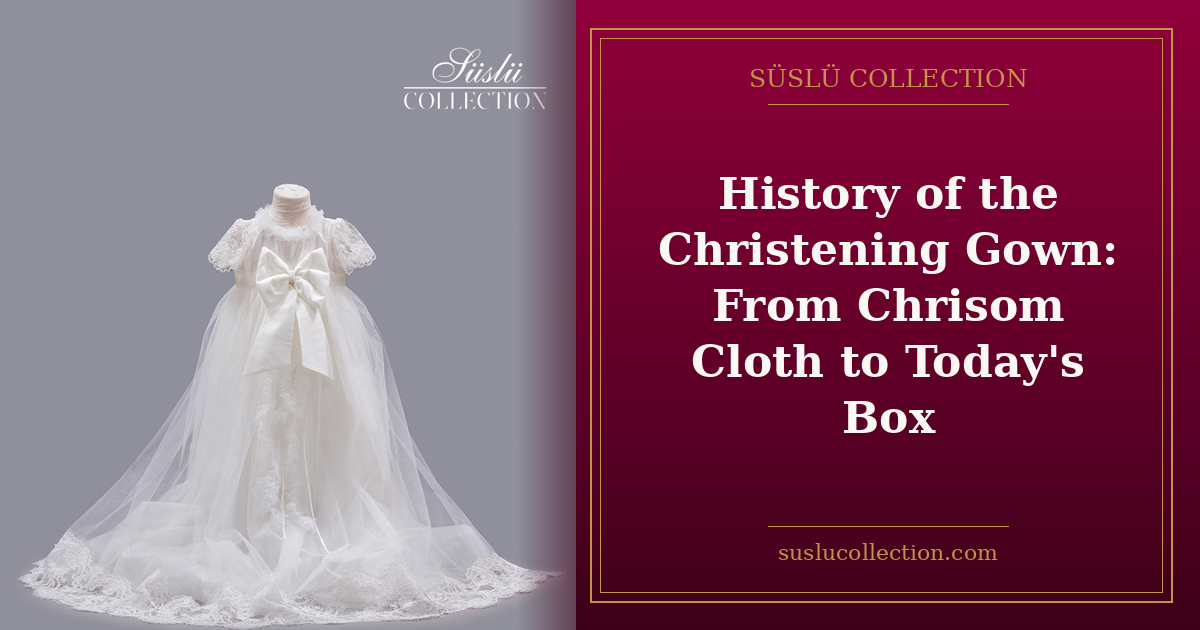
The white gown waiting in its box is the last page of a two-thousand-year story. The christening gown’s history is a history of meaning, not fashion: every era added a layer. 📜
This guide tells the story in five stops, places the Victorian era beside today, and shows history’s five living inheritances one by one.
A family that knows the history dresses the gown differently: knowing it carries not clothing but an inherited tradition. ✨
Master guide: the christening outfit guide · the meaning axis: why white.
Five stops: the layers of meaning
The strip drew five stops; this section tells what each added to the gown. The reading key: no layer was ever lost — all of them stand stacked in today’s gown. 🧅
Which is why a christening gown never goes “out of fashion”: it is the product not of fashion but of continuity.
What did the early church add?
The colour and the meaning: the white worn for a week after baptism was purity’s public sign. That layer’s full story is in the white article.
The Middle Ages’ contribution?
The chrisom cloth: the sacred linen wrapped round the baby served as cover and record at once. Today’s shawl and lap-base tradition is the chrisom’s direct grandchild.
What did the 18th century change?
It freed the body: with swaddling abandoned, the first long, loose baby garments were born. That practical origin of length stands detailed in the length article.
What did the 20th century bring?
Variety: beside the simplified gown came sets and hybrid models — the meaning core untouched. The model map is in the model guide.
Layers counted. Now the brightest era under the glass: the Victorian showcase. 👑
The Victorian era: lace’s golden showcase
The table compares two eras; this section explains why the Victorian one was the turning point. Short answer: in this era the christening gown became the family institution’s showcase. 🖼️
The showcase’s engine was the middle class: as prosperity rose, lace became the visible language of gratitude and means.
Why did hand lace take months?
Because every motif was worked singly: one gown hem was one artisan’s season of labour. Today that inheritance travels in machine-and-hand blends; accessibility is our era’s contribution.
What was the “one gown, all children” order?
Every baby of the family was christened in the same gown: the garment was the family record in fabric. Today’s heirloom habit continues that order consciously — the road map is in the reuse guide.
Where does royalty stand in this era?
At the summit: royal christening gowns became the age’s most famous examples, and the tradition runs today. That story earned its own article: royal traditions.
The showcase era’s lesson for us?
The lesson of dose: display ages, meaning lasts. Today’s aesthetic simplified on that lesson — lace speaks but never shouts.
Showcase toured. Next, the story’s local page: these lands. 🌍
The local page: Istanbul and its communities
The gown’s history is not only a Western European story; on these lands the Greek, Armenian and Levantine communities kept the tradition alive in their own colours. ⛪
The shared ground is the same — white, water, new beginning; the differences live in rite order and accessory.
When is the gown worn in the Greek Orthodox rite?
Usually after the water: the baby arrives plain, and after baptism the white “new garment” is put on — purity’s staging at its most emphatic. That order’s outfit plan is the second scenario in the dressing guide.
The Armenian Apostolic trace?
A rooted rite chain and strong godparenthood: the weight of the godparent tradition reaches the outfit too — the gown is often the godparent’s gift.
What did Levantine families carry?
The European showcase to Istanbul: Victorian-style lace gowns have appeared in the Beyoğlu line’s churches for a century. The city’s ceremony map is in the Istanbul guide.
Today’s Istanbul ceremony as synthesis?
A layer from each: the Orthodox water order, the Armenian godparent weight, the Levantine lace aesthetic — and above all, the same white. The world tour completes in global traditions.
Local page read. Closing: history’s five living inheritances and your own page. 🎁
Five inheritances and your own page
The list counted five inheritances; this section ties each to a decision made today. History is not décor but a user’s manual: every inheritance becomes a choice in the shop. 🗝️
And the story’s beauty is this: the last page is written by you — the gown chosen today is the heirloom of fifty years hence.
Which decision carries the white base?
The tone choice: the snow-or-ecru verdict is the early church colour’s modern fine-tuning. The method stands in the white article.
How is the shawl inheritance kept alive?
By the chrisom gesture: using the shawl only at the ceremony and retiring it to the box salutes the medieval linen. The set build is in the accessories guide.
How is the heirloom inheritance opened today?
With the triple package: lace gown + date embroidery + acid-free box. The stitching journey is in the custom guide; box discipline in the storage guide.
Where does your family page begin?
With one decision: the sentence “this gown stays with us.” For the family that says it, the collection’s heirloom-friendly models stand ready; contact is two lines away.
The history file closes: five stops, one showcase, a local page, five inheritances. Summary below. 🎀
🧵 Notes from the Workshop
The oldest heirloom gowns that reach the workshop are living proof of the Victorian order: one gown, three generations, names pencilled inside the box lid — the bench falls quiet when those boxes open. Second note: families who hear the history raise their embroidery requests; “if it’s a record tradition, stitch our date too” is a weekly classic. Third: in the Greek after-the-water rites our threshold rule turns into tradition by itself — history and practice exit through the same door.
📖 Quick Glossary
Chrisom: the Middle Ages’ sacred white baptismal linen. Showcase era: the Victorian age of display lace. Godparent gift: the outfit given by the godparent. Family record: the register a gown keeps in generation names. Heirloom-friendly: the cut-and-fabric flag for inheritance.
⚡ Quick Summary
The christening gown is a five-layer history: the early church’s white, the medieval chrisom, the 18th century’s freed body, the Victorian lace showcase, the 20th century’s variety. 📜 On these lands the Greek, Armenian and Levantine communities added their own orders. Five inheritances remain: the white base, the shawl, the long hem, heirloom handover, name-date embroidery — and today’s choice writes the last page.
🎯 Next Step
Open your family page today: heirloom-friendly models are flagged in the collection — two lines to contact arrange the date embroidery and the box.
Sıkça Sorulan Sorular
Where does the christening gown tradition come from?
From the early church’s week of white worn after baptism: it evolved through the medieval chrisom cloth, the long garments born when swaddling was abandoned, and the Victorian lace showcase into today’s gown.
How did the Victorian era change the christening gown?
It made it a showcase: hand lace took months of labour, hems passed a metre, and one gown dressed all the family’s children. Today’s heirloom habit is that order’s conscious continuation.
Is there a christening gown tradition in Türkiye?
A rooted one: in the Greek Orthodox rite the gown is usually put on after the water, in the Armenian tradition it is often the godparent’s gift, and Levantine families carried the Victorian aesthetic to Istanbul.
Kaynak: Wikipedia — Baptismal clothing


