

Christening Outfit Guide: Everything from Gown to Heirloom

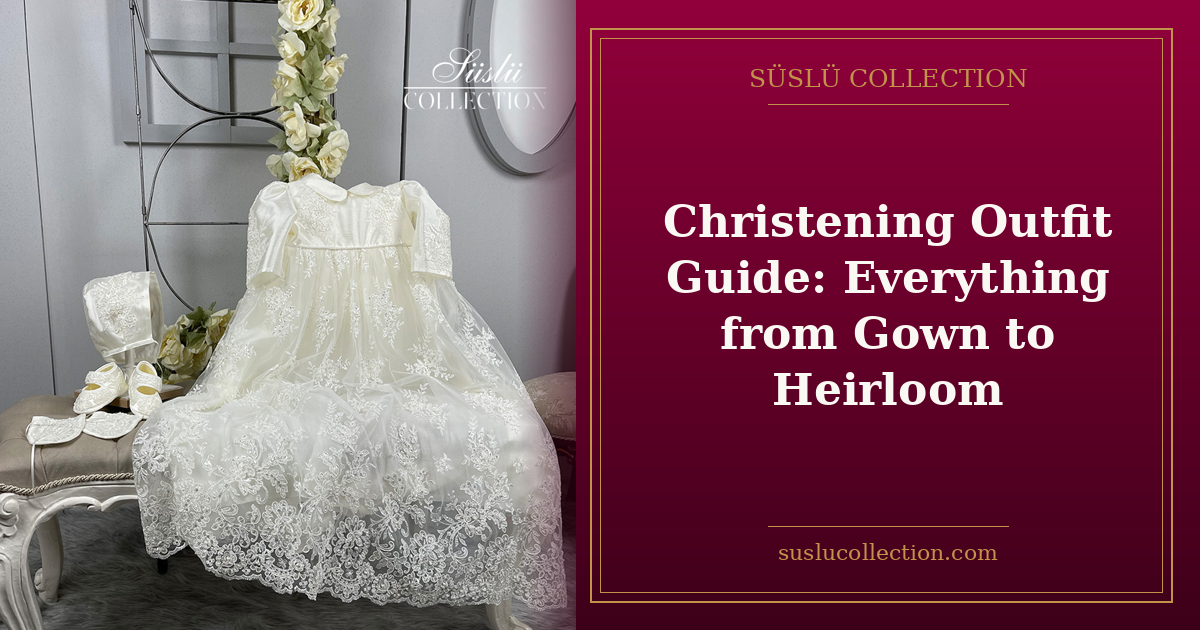
What should a baby wear for a christening? The short answer: a white-family outfit chosen by age, season and the church’s water practice — everything else is detail, and this guide walks through every detail. 🕊️
This is the master guide of our christening collection: model map, fabric and lace, sizing, seasons, the ceremony day itself, accessories, timeline, and the heirloom afterlife of the gown.
Each section links to a deeper article, so you can read this page as a summary or as a doorway. Eighteen doors, one hallway. ✨
Browse as you read: the christening collection and all products are one click away.
The five-step path: from church date to box in hand
The strip above is the whole method in one image. Everything in christening shopping flows from the date backwards: the calendar decides sizing, sizing decides the model, the model decides the set. 🗓️
Golden rule, stated once and repeated often: the box should be in your hands, opened and tried on, one week before the ceremony.
Why does the date come first?
Because babies grow toward the date, not toward today: measurements taken two months early mislead. The full countdown lives in when to prepare.
Which three measurements matter?
Length, chest circumference, head circumference — in centimetres, not month labels. Technique and growth allowance are in the sizing guide.
What if the timeline is short?
Stock size plus express delivery still works at ten days; at 48 hours it depends on stock. Write to us via contact — we answer honestly, never with false promises.
Path set. Now the first big decision: which model? 👗
The model map: five families, one choice
The list names the five model families; the choice runs on two axes: the baby’s age and the ceremony’s rhythm. Lap-age babies wear the long gown effortlessly; movers need shorter hems. 🗺️
Full profiles of every family — with strengths, limits and photo language — are in the model guide.
When is the classic long gown the answer?
From birth to about nine months: the baby is carried, the hem flows, nothing tangles. The waterfall photo is this age’s free gift — its history is told in why gowns are long.
What do boys wear?
A white base with a navy whisper: vest sets, soft suits, bow-tie details. The complete wardrobe is in the boys’ guide.
What is a hybrid model?
A romper body with a gown silhouette: ceremony on the outside, freedom underneath — the 9-14 month zone’s invention.
Model chosen. Next: the tone of white itself. 🤍
White is a family: choosing your tone
“White” is never one colour: the table splits the family into its two poles. The decision reads skin tone and album language — warm skin and lace lean ecru; cool skin and clean surfaces lean snow white. 🎨
The tie-breaker is always the same: photograph both fabrics beside the baby’s face in daylight and let the camera vote.
Why is the whole outfit one white?
Because mixed whites quarrel on camera: gown, bonnet, shawl and booties must pass the daylight test together. The single-white rule is the backbone of the accessories guide.
Where did the white come from?
From the early church’s week of white garments — purity made wearable. The two-thousand-year story is in why gowns are white.
How much colour is allowed?
A whisper: ribbon, embroidery thread, a metallic symbol. The base stays in the white family; full colour belongs to birthdays, not baptisms.
Tone settled. Now the fabric under the tone. 🧵
Fabric and lace: what quality feels like
A christening outfit is judged twice: by the eye in photos and by the skin for hours. Fabric answers both judges — and natural fibre answers them best. 🌿
The 2026 direction confirms the old wisdom: cotton and linen forward, shiny synthetics back — the trend map is in this year’s trends.
What should touch the baby’s skin?
Cotton, always: whatever the outer layer, the lining and undershirt stay soft, seamless, breathable. Comfort is the precondition of every good photo.
How is good lace recognised?
Up close: even stitching, soft hand, shadow depth in the motifs. Quality speaks at thirty centimetres — “quiet luxury” in one sentence.
Machine or handmade lace?
Today’s best work blends both: machine consistency, hand finishing. Heirloom candidates lean toward repairable lace — panels that a workshop can replace decades later.
Fabric learned. Next, the question every parent asks first: the size. 📏
Sizing: three numbers beat one label
Month labels (“6-9 m”) are averages; your baby is not an average. Sizing runs on three measured centimetres plus a growth allowance toward the ceremony date. 📐
The full technique — how to measure a wriggling baby, how much allowance per week — is in the sizing guide; this section keeps the three rules that prevent ninety percent of exchanges.
When are measurements taken?
Two to three weeks before delivery: close enough to be accurate, early enough to order. Measurements taken months early are the classic exchange story.
Between two sizes — up or down?
Up, almost always: gowns forgive room, never tightness. A size confirmed by the workshop beats a size guessed at midnight — send your three numbers via contact.
Does the model change the size logic?
Slightly: gown length is listed separately from body size, and hybrids size like rompers. Each product card in the collection carries its own centimetre table.
Numbers ready. Now the calendar’s other axis: the season. 🍂
Season: fabric and layers by month
The same gown lives differently in July and January. Season picks two words: fabric and layer — summer wants breath, winter wants removable warmth. ☀️❄️
The four-season wardrobe, the air-conditioning trap and the light-and-tone interplay are all in the season guide.
What does a summer baby wear?
Cotton-linen weave, single lining, sparse lace; a lace band can replace the bonnet. One thin shawl rides in the bag for chilled halls.
What does a winter baby wear?
Layers, never one thick piece: cotton undershirt, satin-lined gown or velvet vest, knitted shawl, wool bonnet — each removable as the church warms.
Do stone churches change the plan?
Yes: stone stays cool in every season, so the shawl is a year-round member. Istanbul’s historic churches are the classic case — see the Istanbul guide.
Season set. Now the day itself. ⛪
Ceremony day: the water question decides everything
One question, asked of the church in advance, organises the whole day: does the baby enter the water, or is water sprinkled over the dressed baby? Two answers, two dressing plans. 💧
The minute-by-minute flow — arrival corner, threshold rule, bag order — is in the dressing guide.
What is the threshold rule?
The main outfit is put on at the venue, not at home: the baby travels comfortable, the gown arrives spotless. Ten minutes at the arrival corner buys a pristine ceremony.
How does the immersion order work?
Two acts: the baby enters the water in a simple undershirt, is dried, then dressed in the full outfit — the Orthodox classic, and the most theatrical “new garment” scene.
And the sprinkling order?
The baby is dressed throughout; the hem is gathered at the font and a cloth guards the shoulder. Model choice favours easy neck access.
Day rehearsed. Now the supporting cast: the set. 🧺
Accessories: the five-piece set and its dose
Bonnet, shawl, booties, undershirt, and one symbolic piece: the classic set is five members, all from one white. The dose rule protects the photo: accessories accompany, never compete. 🎀
Member-by-member duties, the daylight test and the bag checklist are in the accessories guide.
Why buy the set in one order?
The single-white guarantee: pieces from one maker match without debate; pieces gathered separately face the daylight test alone.
What is the symbolic piece?
A cross, a medallion, a dated ribbon — metallic allowed, dose small: the symbol glints, the outfit does not.
What waits in the bag?
A comfortable spare outfit for the celebration: the ceremony stage belongs to the gown, the feast belongs to practicality — and the gown’s future thanks you.
Set complete. Two practical chapters left: where and when. 🛍️
Where to buy and when to start
Four buying routes exist and they are not equal: chain stores are seasonal, marketplaces are photo lotteries, fast fashion is single-day fabric — certainty lives with the specialist workshop. The full audit is in where to buy. 🧭
The calendar is the other half: ready-made orders two weeks out, custom tailoring four to five weeks out, everything aiming at the one-week-early box.
What marks a trustworthy product page?
Seven checks: real photos, written fabric content, centimetre size table, set information, written exchange terms, customer proof, and a seller who answers questions before the sale.
When does custom tailoring make sense?
For name-and-date embroidery, heirloom ambitions or non-standard sizes: the brief-to-box journey runs on approved stations, each confirmed by you.
What does the busy season change?
Spring and summer fill workshop and cargo lanes: every band moves one week earlier. The full countdown lives in the timeline guide.
Logistics done. The last chapter looks past the ceremony. 📦
After the ceremony: heirloom, storage, and the long story
A christening gown’s second life begins when the ceremony ends. Stored well, it leaves the box in fifty years looking like the ceremony morning; stored badly, it yellows in two summers. 🕰️
This is also where the gown’s deepest tradition lives: one gown, many ceremonies — the royal family has run a single gown for over 160 years, and the habit scales to any home.
How is the gown stored?
Five steps: stain check within 24 hours, gentle cleaning, full shade-drying, acid-free tissue and box, labelled dark-dry-cool shelf. The enemies — plastic, sunlight, wire hangers — are listed in the storage guide.
How is an heirloom worn again?
By planned handover: open the box 4-6 weeks early, inspect, clean or repair, fit the new baby, add the new name embroidery. The whole ritual is in the reuse guide.
Where does the tradition itself come from?
From a two-thousand-year story — early-church white, medieval chrisom cloth, Victorian lace — told in the history article, its royal chapter in royal traditions, and its world tour in global customs.
The circle closes: choose, celebrate, box, hand over. Summary below. 🎀
🧵 Notes from the Workshop
Three patterns repeat across hundreds of orders. First: families who send their three measurements and ceremony date get a confirmed size in one message — exchanges nearly vanish. Second: the one-week-early box turns ceremony week into family time; late boxes turn it into cargo-tracking week. Third: the quiet growth of the heirloom question — “will this last fifty years?” — now shapes more choices than any trend; we answer with fabric, cut and a line of embroidery.
📖 Quick Glossary
Gown: the long classic christening dress. Single-white rule: all set pieces from one tone. Threshold rule: dressing the baby at the venue. Water order: immersion vs. sprinkling practice. Chrisom: the medieval white baptismal cloth. Acid-free box: archival storage that prevents yellowing.
⚡ Quick Summary
The method is five steps: confirm the date, take three measurements, pick the model by age and rite, match the set from one white, deliver one week early. 🕊️ White is a family — snow for cool tones, ecru for warm and heirloom lace. Season picks fabric and layers; the water question picks the dressing plan; the specialist route with seven page-checks picks the seller. After the ceremony, five storage steps and a planned handover turn the outfit into a family heirloom.
🎯 Next Step
Send your ceremony date and the baby’s three measurements via contact — we confirm size and model the same day; the christening collection is ready with real photos and centimetre tables.
Sıkça Sorulan Sorular
What does a baby wear for a christening?
A white-family outfit chosen by age and rite: the classic long gown for lap-age babies, knee-length or hybrid models for movers, and a white suit with a navy whisper for boys. The set — bonnet, shawl, booties, undershirt — comes from the same single white.
When should a christening outfit be ready?
The box should be in hand, opened and tried on, one week before the ceremony: ready-made orders go in two weeks out, custom tailoring four to five weeks out, and everything moves a week earlier in the busy spring-summer season.
Does the baby wear the gown in the water?
It depends on the church’s water order: in the immersion practice the baby enters the water in a simple undershirt and is dressed afterwards; in the sprinkling practice the baby stays dressed and water is sprinkled with the hem gathered. Ask the church in advance — the answer decides the dressing plan.
Kaynak: Wikipedia — Baptismal clothing


