

Christening Keepsake Box Guide: From Choosing to Storing
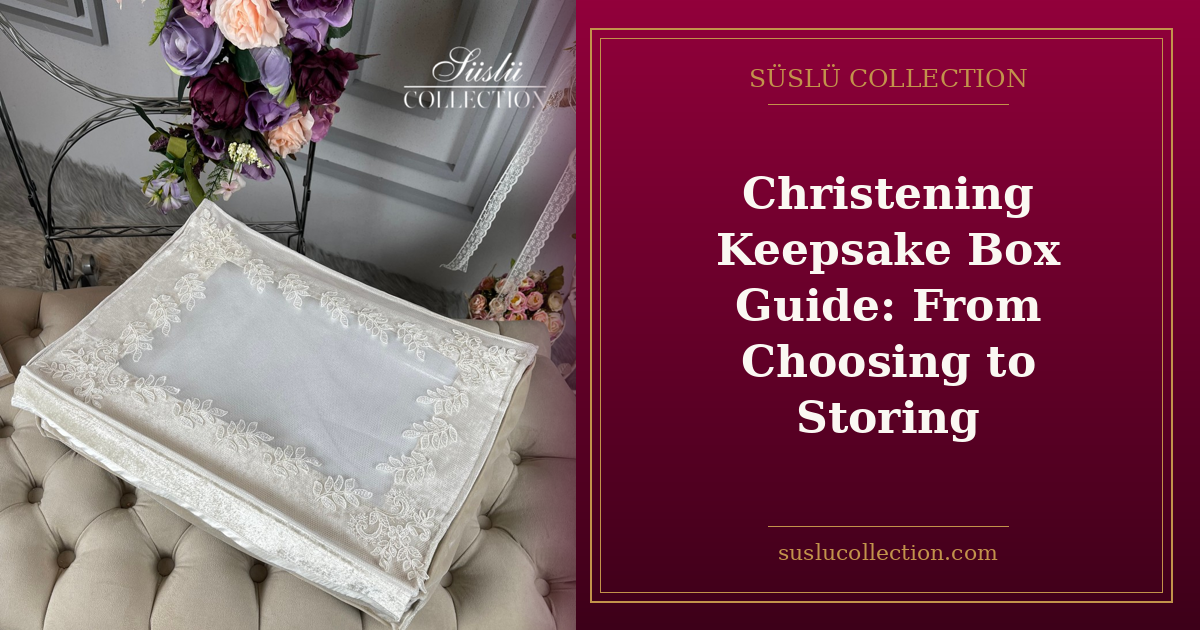
What is a christening keepsake box, and how do you choose one? Short answer: it is a lidded keepsake box that carries the ceremony items, sits on display at the celebration and is kept for years — its size follows the outfit, its fabric the ceremony, its trim the family. 🎁
This guide brings together the box’s jobs, what goes inside, the difference between velvet, satin and quilted boxes, personal embroidery, its place on the ceremony day and how to store it; each topic’s deep dive is linked along the way.
Let’s say it upfront: the box isn’t packaging, it’s the first container of a family memory — it will keep the outfit it carries today with the same care twenty years from now. ✨
For the outfit side: christening outfit guide · box styles: keepsake box collection.
What is the box for? Four jobs
The list set out the jobs; this section opens each one. The box’s secret is simple: the same box does today’s work and tomorrow’s — it carries to the ceremony, displays at the table, protects in the cupboard and reminds years later. 🧺
Thinking of all four jobs together is the first step to choosing the right box.
Why does carrying matter?
Christening mornings are busy: when the gown, bonnet, booties, mittens, candle and small accessories are gathered in one box, nothing is left at home. A lidded box brings these pieces to the ceremony uncrushed and dust-free.
What does displaying mean?
On the ceremony table or welcome corner, the box stands open or closed: it shows the family’s care and the elegance of the chosen fabric and embroidery. It’s a detail that often appears in photos.
What does protecting cover?
Lace, tulle and satin need protection from light, dust and crushing: a lidded, lined box provides it. It offers far more breathable storage than a plastic bag.
How does remembering work?
A box opened years later brings out the first outfit, the first booties, the ceremony invitation and perhaps a photo together. That’s why many families plan to open it on the child’s eighteenth birthday.
Is it only for christenings?
Its name is tied to christenings, but the same logic applies to birth, first-birthday and other ceremony keepsakes: every family needs a keepsake box.
Is the box given as a gift?
Very often: godparents or grandmothers give the box and the family fills it. A name-embroidered box is one of the most lasting gifts to remember the ceremony by.
The jobs are clear. Now the contents. 📦
What goes inside the box?
A well-prepared box is thought of in three layers: the ceremony outfit, the ceremony accessories and the keepsakes. This section gives each layer briefly; the detailed list is in its own piece. 🗂️
Order matters too: heavy pieces at the bottom, delicate ones above, papers on top.
What’s in the outfit layer?
The christening gown or suit, the underlayer, socks and booties: folded with acid-free paper and laid at the bottom. For choosing the outfit, see the christening outfit guide.
And the accessory layer?
Bonnet or hat, the christening towel, a small cross necklace, the ceremony candle and ribbons: in the middle, in a separate compartment above the outfit. All accessories are in the christening accessories piece.
What does the keepsake layer hold?
The ceremony invitation, the christening certificate, a first photo, a note from the godparents: on top, inside an envelope. This is the layer that greets whoever opens the box years later.
What shouldn’t go in?
Anything that holds moisture or leaves colour: plastic bags, perfume, fresh flowers, metal clips. Dried flowers should sit in a separate paper envelope. The list is in the what to put inside piece.
A separate box for each sibling?
Each child is best given their own box: a keepsake box is personal, and name embroidery completes that. Sibling boxes in the same fabric with different embroidery make a lovely pair on the shelf.
The contents are ready. Next, fabric. 🧵
Fabric: velvet, satin, quilted
The table compared the two main fabrics; the third is quilted. The rule is simple: the box’s fabric should speak with the ceremony outfit — neither should overpower the other. 🎨
When choosing, think of both the ceremony’s season and the years the box will spend in a cupboard.
Who suits velvet?
Those who want a warm, deep look: lace or French embroidery on velvet looks exquisite; it stands out at winter ceremonies and in cream-beige tones. Example: French-embroidered velvet box.
When is satin chosen?
When a bright, glossy unity is wanted: satin speaks directly with a white satin christening gown and looks fresh at summer ceremonies. Because it shows stains, it needs careful carrying.
What makes quilted different?
Padded squares formed by stitching give a soft, protective surface: pleasant to touch and a light buffer against knocks. Combined with tulle or lace trim it takes on a classic look.
Why does the inner lining matter?
The inner lining is the surface that touches the outfit: a soft, light-coloured lining that doesn’t bleed colour protects delicate fabrics. Always look inside when choosing a box.
Which colours are preferred?
White, off-white, cream and blush: the calm tones of christenings. The full comparison is in the box styles piece.
The fabric is set. Now personalisation. ✍️
A personalised box: embroidery and trim
What turns a box into a family keepsake is personalisation: a name, a date, a motif. This section covers trim and embroidery options under the one-focus rule. 🪡
The one-focus rule applies here too: if there’s embroidery, the lace stays simple; if lace leads, the embroidery stays small.
Where does name embroidery go?
Usually in the centre of the lid or at the lower front: the child’s name and the ceremony date. The lettering is chosen by fabric; script looks lovely on velvet, simple letters on satin.
What trims are available?
Lace appliqué, tulle bows, floral embroidery, French embroidery, pearls and small crystals. Parts that small children could reach and pull must be sewn on firmly.
How is a motif chosen?
A symbol meaningful to the family: a flower, a branch, a cross or simply initials. A simple motif never dates, however many years pass.
How long does a personalised box take?
Two to three weeks depending on embroidery and trim: design approval, embroidery, assembly and photo check. The process is in the name-embroidered box piece.
Can it share a motif with the outfit?
It can, and it looks very elegant: when the lace on the gown repeats on the box lid, the set looks like a single whole.
How is the language of the text chosen?
The family’s language or the child’s christening name: bilingual families may prefer the name on the lid and a short note inside. Legible letters come before decoration.
Personalisation is done. Next, the ceremony day. ⛪
Ceremony day: where does the box sit?
On the ceremony day the box plays a role in two scenes: the dressing room and the welcome or keepsake table. This section covers both briefly. 🕯️
Good placement is both practical and photo-friendly.
In the dressing room?
The box stays open while the baby is dressed: each piece comes out in turn, and when it’s done the baby’s morning clothes go into the box. That way nothing is left lying around.
On the keepsake table?
Lid slightly open, with a candle, a photo and a few flowers beside it: while guests write in the guest book, the box sits at the centre of the table. For table setup, see the ceremony table piece.
Is the box opened in church?
Usually not: inside the church the box stays closed, and only the piece needed (towel, candle) is taken out. Asking the church about its rules in advance is best.
How does it look in photos?
In side-lit daylight, lid half open: this is how the embroidery and the fabric’s texture show best. Flash causes glare on satin.
What happens after the ceremony?
At home the outfit doesn’t go straight into the box: first it’s aired, checked for stains and cleaned if needed. Then it’s settled into place with acid-free paper.
The ceremony is covered. Next, the difference between a box, a carton and a bundle. ⚖️
Keepsake box, carton, bundle: what’s the difference?
Families often ask: “Wouldn’t a cardboard box or a fabric bundle do?” They would — but the three don’t do the same job. This section sets the difference out clearly. ⚖️
The decision depends on which of the box’s four jobs you need.
What does a cardboard box cover?
Only carrying: cheap and practical, but it absorbs moisture, contains acid and can yellow the outfit over time. It has no display or keepsake value.
What does a fabric bundle cover?
Wrapping and tradition: a fabric bundle breathes and is part of Anatolian trousseau culture. But without a lid it stays vulnerable to crushing and dust.
What does a keepsake box add?
A lid, a frame and an inner lining: it combines the bundle’s breathable fabric with the protection of a box. It can be displayed at the ceremony and keeps its form in a cupboard for years. The story of this tradition is in the from bundle to box piece.
Why prepare a keepsake box?
Because a ceremony lasts a day, a memory a lifetime: the box ties that day to a tangible object. Its meaning is in the why prepare a box piece.
How should budget be viewed?
A box is a one-time purchase used for years: investing in fabric and workmanship means an outfit that doesn’t yellow and a memory that doesn’t fade.
The difference is clear. Next, the final preparation before the day. 🗓️
Five steps to choosing a box
The strip listed the steps; this section gives each one’s trick. Order matters: size sets the fabric, fabric sets the trim, trim sets the calendar. 🧭
The five steps come together in an evening; ordering is easy after that.
How is size measured?
Measure the space the folded christening outfit takes, then add room for accessories and papers: the outfit should lie comfortably, uncrushed. Long christening gowns need a wider box.
How is fabric chosen?
By the ceremony’s season and the outfit’s tone: velvet for winter and cream tones, satin for summer and white tones, quilted for a soft, classic look.
How is trim decided?
One focus: lace, embroidery, tulle or flowers — one leads. Using the same motif as the outfit strengthens the unity.
Is personalisation necessary?
Not required, but it’s the detail that makes the box a family keepsake: name and date embroidery speaks directly to the child who opens it years later.
When should you order?
At least two to three weeks before the ceremony for an embroidered box, one week for a ready-made model. Calendar details are in the when to prepare piece.
The steps are done. Last section: the box over the years. ⏳
The box over the years: storing and passing on
A box’s real value appears after the ceremony day: a well-kept box passes from generation to generation. This section gives the principles of storing and passing it on. 🏺
Three rules are enough: dark, dry, breathable.
Where should the box be stored?
In a cupboard away from sunlight with low humidity: basements and attics aren’t suitable because of temperature and humidity swings. The box should lie flat, with nothing heavy on top.
How are the contents protected?
Acid-free paper, cotton pouches and airing once a year: this prevents yellowing and permanent fold marks. Storage principles are in the christening gown storage piece.
How is the box itself cleaned?
Velvet with a soft brush, satin gently with a clean damp cloth, quilted with a vacuum on low suction: it is never immersed in water.
When is the box opened?
Some families at the child’s first communion, some at eighteen, some at their own child’s christening: the opening is one of a family’s most emotional gatherings. Details in the next generation piece.
Where can you find a box?
Velvet, satin and quilted models are in the keepsake box collection; for name and date embroidery, write via contact and a design proposal comes back the same day.
The guide is complete: jobs, contents, fabric, personalisation, ceremony, calendar, storage. Summary below. 🎀
🧵 Notes from the Atelier
The sentence we hear most with box orders is “I didn’t know how to keep the outfit” — the box answers that in one move. Second note: name-embroidered boxes are the products families share photos of most. Third note: we always give families who put the outfit away without airing it the same reminder: air first, then paper, then lid.
📖 Quick Glossary
Keepsake box (hurç): a lidded box that carries and stores ceremony items. Quilted: a padded surface divided into squares by stitching. Acid-free paper: storage paper that keeps fabric from yellowing. Keepsake layer: the top compartment holding invitation, certificate and photo.
⚡ Quick Summary
A christening keepsake box does four jobs: carry, display, protect, remember. 🎁 Three layers go inside: outfit, accessories, keepsakes. The fabric speaks with the ceremony: velvet warm, satin bright, quilted soft. Name-and-date embroidery makes it a family keepsake and takes 2-3 weeks. For storage, a dark, dry, breathable cupboard, acid-free paper and airing once a year are enough.
🎯 Next Step
Write the ceremony date and the embroidery you’d like via contact — a design proposal the same day; models in the keepsake box collection.
Sıkça Sorulan Sorular
What is a christening keepsake box?
A christening keepsake box is a lidded box, usually covered in velvet, satin or quilted fabric, that carries the ceremony outfit, accessories and keepsakes in one place, is displayed on the ceremony table and is kept for years as a family memory.
What goes inside a christening keepsake box?
Three layers: the christening outfit, socks and booties at the bottom; accessories such as bonnet, towel, candle and ribbons in the middle; and keepsakes such as the invitation, christening certificate and photo on top. Plastic bags and perfume don’t go in.
How long does a personalised embroidered box take?
With design approval, embroidery, assembly and a photo check it takes around two to three weeks on average. Ready-made models can be sent within a week; the box should be home before the ceremony.
Kaynak: Wikipedia — Baptism
Christening Keepsake Box
Browse Products


