

Why Prepare a Christening Keepsake Box? Meaning and Value
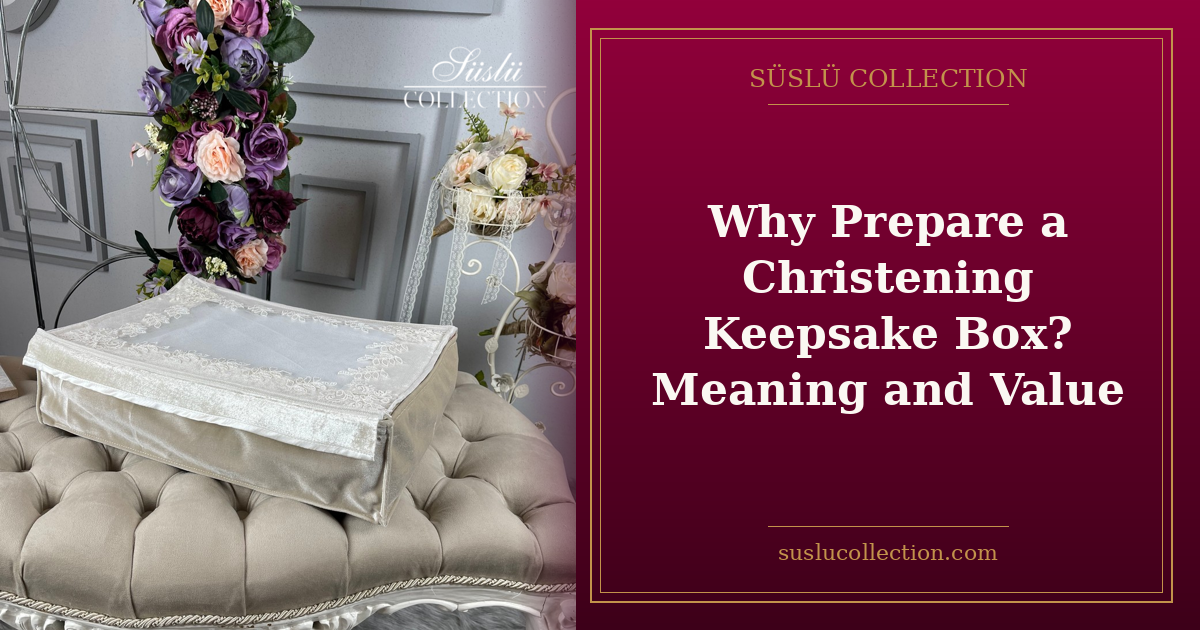
Why prepare a christening keepsake box? Short answer: because a ceremony lasts a day, a memory a lifetime — the box carries that day in order, protects delicate fabrics and keeps the family’s story in a tangible object. 💫
This piece covers five reasons to prepare a box, the difference between twenty years with and without one, and the path a box walks over a lifetime.
A keepsake box isn’t an accessory but an intention: the simplest way of saying “we won’t forget this day”. ✨
Main guide: christening keepsake box guide · the tradition’s story: from bundle to box.
Five reasons to prepare a box
The list set out the reasons; this section opens the truth behind each. The five gather under two headings: useful today, meaningful tomorrow. 🧭
Most families buy a box for a practical reason and keep it for an emotional one.
Why is order first?
Christening mornings are hectic: baby, guests, photographer, church time. When the outfit, bonnet, booties, candle and towel are ready in one box, nothing stays at home.
Why does protection matter?
Christening outfits are often lace, tulle and satin: light yellows them, dust greys them, plastic bags trap damp. A lidded, lined box protects against all three.
How does meaning form?
Human memory holds on to objects: when a box is opened, a tiny bootie inside brings back a feeling photos can’t tell.
What does continuity mean?
Keeping family things in boxes, chests and fabric bundles is a habit that has lasted generations: the keepsake box is its elegant present-day form.
Why is it chosen as a gift?
It’s a lasting present for godparents and grandmothers: a name-embroidered box makes the giver part of the story too.
Is it only for girls?
No: a baby boy’s christening suit, hat and booties deserve the same care. Fabric and trim change, the box’s job stays the same — simple velvet or quilted styles are often chosen for boys.
The reasons are clear. Now the comparison. ⚖️
Twenty years with and without a box
The table set the two scenarios side by side; this section makes the difference concrete. The difference doesn’t show on the ceremony day but years later. ⏳
The same outfit, the same family, two different endings.
What happens without a box?
The outfit goes into a bag and is pushed to the back of a wardrobe; it moves around with each house move. Found years later, it has yellowed, a bootie is missing and the invitation has ended up in another folder.
What happens with a box?
Everything is in one place, folded and papered: the outfit clean, accessories in their pouches, the keepsake envelope on top. Opening the box becomes a family gathering.
What changes when moving house?
A box is a single, recognisable item: a box labelled “christening” doesn’t get lost among cardboard cartons.
And between siblings?
When each child has their own box, the question of whose things are whose never arises: name embroidery makes it clear even years later.
Isn’t a digital photo enough?
A photo keeps the image, a box keeps the touch: the fineness of the lace, the smallness of the bootie and the scent of the fabric can’t be lived on a screen. The two complete each other; a printed photo in the keepsake envelope joins them.
Is the cost worth it?
A box is bought once and used for years: the cost of rescuing a yellowed lace gown often exceeds the box itself.
The difference is seen. Next, the box’s path. 🛤️
A box’s lifelong journey
The strip drew the stops; this section explains what the box does at each. A box is a living object: it’s born on the ceremony day and grows over the years. 🌱
Each stop adds a new layer to the box’s meaning.
What does it do on the ceremony morning?
It carries: outfit and accessories reach the church orderly and uncrushed. The contents list is in the what to put inside piece.
What does it do at the ceremony table?
It displays: lid slightly open, with a candle and a photo beside it. Guests see the family’s care in the box. Table setup is in the ceremony table piece.
What happens in the early years?
It grows: first-birthday booties, a first-tooth box, a first drawing are added. The box becomes a small archive of the child’s early years.
What happens at eighteen?
It’s handed over: many families give the box to the child on their eighteenth birthday. For the first time they hold their own story in their hands.
What happens in the next generation?
It’s opened again: at their own child’s christening, the old outfit is sometimes worn again, sometimes displayed beside the new box. Details in the next generation piece.
Where does the box live at home?
On a shelf in the child’s room or in the parents’ wardrobe: if it’s somewhere visible, the family touches it, remembers and tells the story often.
The path is drawn. Last section: what families say. 💬
What a box gives families
A box’s value is best understood at the family table: a box is opened and everyone falls quiet and looks. This section covers four things a box gives families. 🏡
All lead to the same feeling: belonging.
Does it make storytelling easier?
Yes: when a child asks “How was I christened?”, the answer is inside a box. Photo, booties and invitation tell the story on their own.
What does it mean for elders?
A bridge between generations: a piece of lace touched by a grandmother or a godfather’s note makes the family bond tangible.
What does it give the child?
An object from their own beginning: holding one’s personal history creates a strong sense of belonging.
What does it add to the ceremony day?
Calm and grace: when everything is ready in one box, the family focuses on the moment rather than the rush.
Where to begin?
Models are in the keepsake box collection; write the name and ceremony date via contact for a personalised proposal the same day.
The meaning file closes: reasons, difference, path, family. Summary below. 🎀
🧵 Notes from the Atelier
The story families tell us most is finding their own christening outfit yellowed in a bag — which is why they prepare a box for their children. Second note: families who hand the box over at eighteen describe that moment as one of the family’s most emotional days. Third note: boxes gifted by godparents, together with their notes, are the most carefully kept of all.
📖 Quick Glossary
Keepsake box: a lidded box that carries and stores ceremony items. Memory archive: a box collecting objects from a child’s early years. Handover day: the day the box is given to the child, most often at eighteen. Godparents: the people who stand witness at a child’s christening.
⚡ Quick Summary
A box is prepared for five reasons: order, protection, meaning, continuity, gift. 💫 Twenty years without a box leave a yellowed, scattered memory; twenty years with one, a clean story kept together. The box’s path: ceremony morning, ceremony table, early years, age eighteen, the next generation. It gives families story, bond and belonging.
🎯 Next Step
Write the name and ceremony date via contact — a personalised proposal the same day; models in the keepsake box collection.
Sıkça Sorulan Sorular
Why prepare a christening keepsake box?
To carry the outfit and accessories in order on the ceremony morning, to protect delicate fabrics from light, dust and damp, and to tie the ceremony to a tangible memory kept for years. It’s also a lasting gift option for godparents.
When is the box given to the child?
It varies by family: many hand the box over on the child’s eighteenth birthday; some open it at first communion, others at the child’s own child’s christening.
Can things be added to the box later?
Yes. First-birthday booties, a first-tooth box or a first drawing can be added; over time the box becomes a small archive of the child’s early years. The lid just needs to close comfortably, with each piece in its own pouch.
Kaynak: Wikipedia — Baptism
Christening Keepsake Box
Browse Products


