

Where to Buy Veiling Fabric: Types, Sources and 4 Counter Tests
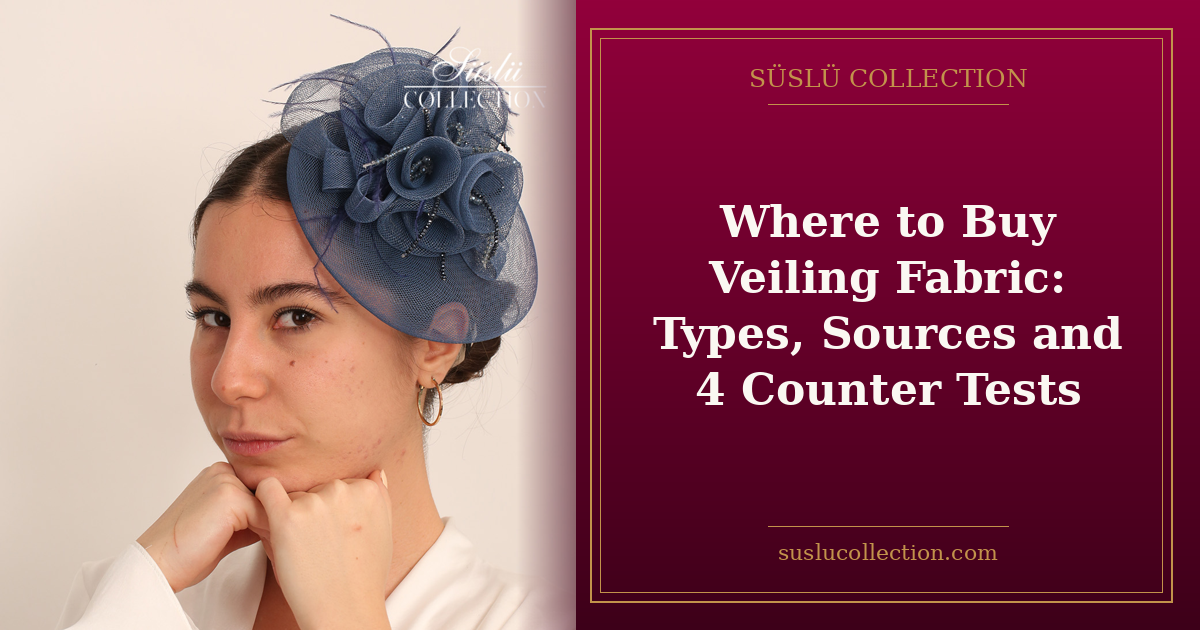
Sewing your own headpiece, refreshing an heirloom, or just curious what “French net” costs by the metre? Then the hunt is for veiling fabric — and the hunt has rules. 🧵
The market sells three different things under one word “tulle”, and only one of them stands, frames and photographs like a birdcage veil.
This guide names the four netting types, maps where real veiling is sold, and hands you four thirty-second tests that separate millinery net from curtain material. ✨
Main guide: the wedding hat guide · buying finished pieces: where to buy a bridal hat.
First, speak the language: the four veiling types
Walk into a fabric district asking for “tulle” and you will be shown everything except what you need. The four names above are the vocabulary; here is each one’s character. 🗣️
One dimension explains most of the difference: gauge — the size of the diamond openings.
What makes French net the birdcage classic?
Wide diamonds and natural stiffness: it stands away from the face, frames without touching, and reads unmistakably millinery. When product pages say “merry widow”, this is the fabric.
When does Russian net win?
When subtlety leads: finer diamonds drape closer and softer — the choice for quiet elegance and for faces that find wide gauge theatrical. Many ateliers stock both and let the mirror decide.
Why is bridal tulle the wrong buy here?
Softness: tulle is engineered to gather in clouds for long veils, not to stand. On a headpiece it collapses into fog instead of frame — the single most common DIY disappointment.
What do the dots add?
Instant era: flocked chenille dots turn French net vintage on contact. Dot spacing matters — sparse reads elegant, dense reads playful; the black dotted version is decoded in the black veil guide.
Vocabulary learned. Now the map: where the real thing is sold. 🗺️
The hunting map: reliable grounds and dead ends
Veiling is a niche inside a niche, and most fabric retail never touches it. The map above saves the wasted trips; here is the reasoning. 🧭
The pattern: veiling lives wherever milliners themselves shop — follow the trade, not the signage.
What do specialist suppliers offer?
The full vocabulary in stock: French, Russian, dotted, in named colours, cut by the metre. Online suppliers ship samples — order swatches first, always, for the same tone reasons finished hats demand daylight checks.
How do fabric districts work for veiling?
Historic districts in major cities hide one or two counters that know the word “millinery” — ask for it by name, not “tulle”. The stand test, run at the counter, separates the real shelf from the neighbour’s curtain roll.
Why do craft chains disappoint?
Their net is costume-grade: right look at arm’s length, wrong behaviour on camera and wrong stiffness in wind. Fine for a party prop, not for a wedding head.
What about atelier offcuts?
The insider route: working ateliers sell metre lengths and offcuts of exactly what their own pieces use. Ours does — ask what is on the bench via contact, tone and metre in one message.
Grounds mapped. Before money changes hands: the four tests. 🔬
The four tests: thirty seconds each, run at the counter
Labels lie more often in fabric than anywhere else in this hunt — “French net” is typed onto anything diamond-shaped. The four tests above outrank every label. ⏱️
Together they check the four things a headpiece will demand: stand, memory, weave, tone.
What does the stand test prove?
Structure: held upright by a corner, real veiling holds its plane; tulle and curtain net fold over immediately. This single test eliminates most impostors.
Why does crush memory matter?
Because the piece will travel, be stored and be hugged: good net springs back crisp from a squeeze. Net that stays creased at the counter will stay creased in every photo.
What is the light test reading?
Weave honesty: against a window, diamonds should run even, knots clean, no fused or torn cells. Irregular weave prints itself across your face in close-ups — the camera magnifies what the eye forgives.
And the match test?
Tone, judged by the sun: veiling on dress fabric, by a window, photographed. White families argue more than any other colour; the match test settles ivory versus optic in one frame.
Tests passed, metre bought. Last chapter: quantities, tools and the honest DIY line. ✂️
Quantities, tools and the honest DIY line
The fabric is the easy half; the honest question is what happens at the table. Here is what a headpiece actually consumes — and where DIY wisely hands over. 🧷
Good news first: veiling projects are small-fabric projects — the investment is courage, not metres.
How much veiling does a piece need?
A birdcage veil runs on roughly half a metre; a generous full-face design under a metre. Buy double your plan: the second attempt is the universal beginner’s tax, and offcuts become practice ground.
What tools join the fabric?
Sharp fabric scissors, millinery wire or a comb base, matching thread, pins — a kit that fits a shoebox. Cutting veiling follows the diamond lines; against the weave, edges fray into fuzz.
Where is the honest DIY line?
Gathering and mounting netting: achievable with patience. Tone-dyeing, blocked bases and heirloom-grade finishing: bench craft — the point where the custom process takes the baton with your fabric welcome in hand.
And if the hunt itself tires you?
The shortcut stands open: the collection’s finished pieces carry the same French and Russian nets, tested and mounted. The hunt teaches; the shelf delivers.
Fabric named, sourced, tested, budgeted. The summary ties the bundle below. 🎀
🧵 Notes from the Atelier
The parcel we open most warily: customer-supplied “French net” bought online — half the time it is standard tulle, and the project restarts at the swatch stage. Swatches first is the whole sermon. Second note: fabric-district sellers light up when you say “millinery” — the word unlocks the back shelf where the real rolls live. Third: brides who sew their own veiling almost always return for the mounting — and we love those benches best: their fabric, our finish, one story.
📖 Quick Glossary
Gauge: the size of the net’s diamond openings. Merry widow: trade name for wide-gauge French net. Flocked dot: the fused chenille dot on vintage-style net. Swatch: a small sample cut sent before a metre order. Blocking: shaping a hat base over a form — bench craft.
⚡ Quick Summary
One word “tulle” hides four fabrics; only French and Russian net stand and frame. 🧵 Real veiling sells where milliners shop: specialist suppliers, the millinery counters of fabric districts, atelier offcuts — not craft chains or curtain rolls. Four counter tests outrank every label: stand, crush, light, match. Half a metre builds a birdcage; buy double, cut along the diamonds, and hand dyeing and blocking to the bench.
🎯 Next Step
Swatch before metre: ask what veiling is on our bench via contact — or skip the hunt entirely and meet the same nets finished in the collection.
Sıkça Sorulan Sorular
What fabric is used for birdcage veils?
French net (merry widow) is the classic: wide diamond gauge with natural stiffness that stands away from the face. Russian net is the finer, softer alternative; standard bridal tulle is too soft for structure.
Where can I buy French netting for a veil?
From specialist millinery suppliers, the millinery counters of historic fabric districts, or working ateliers selling by the metre. Ask using the word millinery, and order swatches before metres.
How much netting do I need for a birdcage veil?
About half a metre for a classic birdcage, under a metre for a generous full-face design. Buy double your plan — the second attempt is the beginner’s universal tax.
Kaynak: Wikipedia — Tulle (netting)
Bridal Hats & Veils
Browse Products


