

Christening Traditions Around the World: Six Stagings of One White

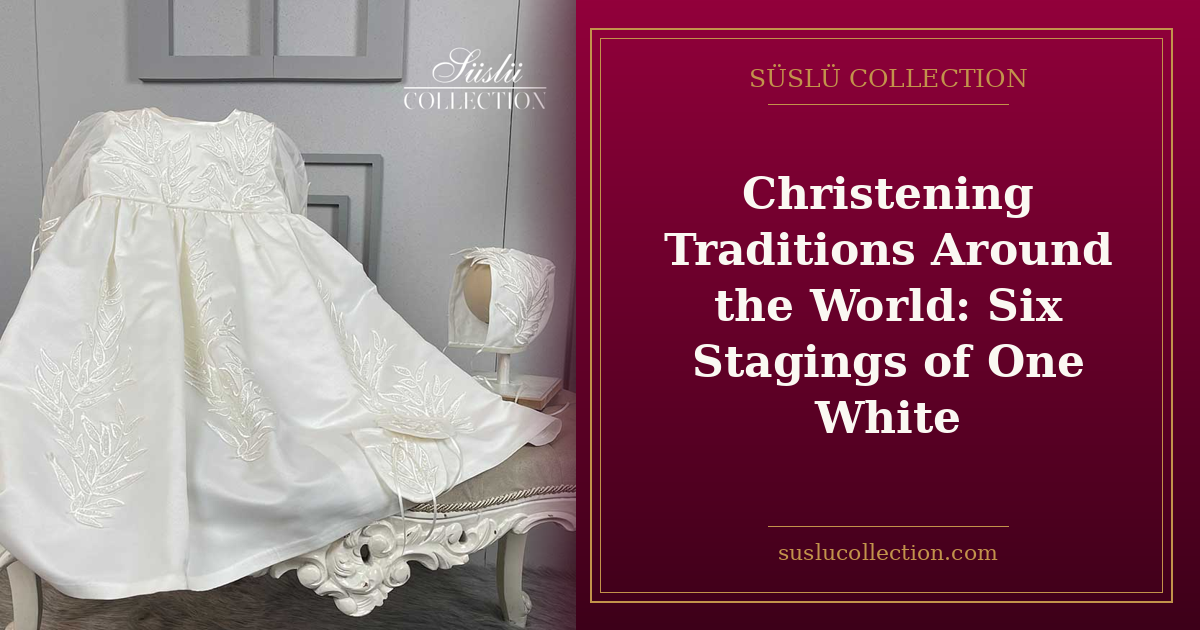
The same white is worn differently on six continents. A world tour of christening traditions shows how many stagings one meaning — water, white, new beginning — can hold. 🌍
This guide visits six stops, compares the two rite orders that split the world, and selects four inspirations to carry into your own ceremony.
The tour gives more than curiosity: other families’ solutions are your ceremony’s idea notebook. ✨
Master guide: the christening outfit guide · the local page: the gown’s history.
Six stops: six stagings of one white
The list summarised the tour; this section lands at four stops. The common point never moves: the white base and the new beginning — the difference lives in staging and family roles. 🎭
Read with a pen: every stop hides at least one gesture that travels home.
What is the Greek ladopano?
Named after the anointing cloth: the baby is blessed with oil, then dressed head to toe in new white after the water, and the godparent circles the font three times. The most theatrical form of the “new garment” scene.
What does the Mediterranean medallion say?
In Italian and Spanish families a family medallion accompanies the gown: the token is a bridge between generations. The metallic symbol’s dose rule is ours too — the white article’s boundary section.
Why is the Scandinavian hem a register?
Into the plain linen gown’s hem a name is embroidered at every christening: the garment becomes the family’s fabric census. Our date-embroidery suggestion draws from exactly this source.
Why is the Filipino binyag so crowded?
The godparent circle is wide: dozens of ninong and ninang weave the baby’s net of care. The outfit is still a white set; the crowd makes the backup routine mandatory.
What does Ethiopia’s 40/80 day teach?
Timing itself: boys are baptised on the 40th day, girls on the 80th, wrapped in the white shamma. The calendar is part of the tradition.
Stops visited. Now the question that splits the world: does the gown enter the water? 💧
Two orders: before the water or after?
The table compares the world’s two rite orders; the outfit plan’s entire branching grows from this split. Knowing your order simplifies every decision from model choice to bag packing. ⚖️
The golden question never changes — asked of the church: “how is the water done here?”
How is the plain-entry plan built?
In two acts: act one a simple undershirt, act two the full stage on a dried baby. The gown never gets wet; hair-drying order steps forward — the flow is in the dressing guide.
Risk management in the dressed blessing?
Sprinkling is measured, but precautions stand: the hem gathers over the arm, a thin cloth guards the shoulder. Easy-neck models are this order’s friends — options in the model guide.
Which order do Istanbul’s communities follow?
Both live: Greek Orthodox rites mostly plain entry, Catholic-Protestant rites mostly the dressed blessing. The city map is in the Istanbul guide.
What do dual-tradition families do?
The hosting church’s order is followed; the other tradition’s gesture — medallion, shawl, name embroidery — joins the outfit as a detail. Two worlds meet in one garment.
Order settled. Next, the tour’s harvest: four inspirations for home. 🎁
Four inspirations: the tour’s harvest
The strip picked four inspirations; this section turns each into an applicable step. The selection rule was simple: gestures that join today’s ceremony without effort. 🧺
All four are not required; even one personalises the ceremony.
How is the name embroidery begun?
With the first name: the baby’s name and date stitched inside the hem, later generations added below. The Scandinavian register opens this way — the stitching journey is in the custom guide.
How does the medallion stay dosed?
The single-piece rule: one medallion or cross, ribbon-fastened to the gown, retired to the box after the rite. The shine stays in the symbol, never spilling onto the outfit.
How is the godparent-gift routine arranged?
By early conversation: if the godparent buys the gown, size and model run in one message thread. The three-way exchange — family, godparent, workshop — is a routine we happily host via contact.
What does the stage-feast split protect?
The gown’s lifespan: the ceremony stage belongs to the gown, the feast to a comfortable spare. From the Filipino crowd to an Anatolian table the rule holds — food never touches the heirloom.
Harvest gathered. Closing: the shared core under all differences. 🕊️
The shared core: one meaning under every staging
Six stops, two orders, dozens of gestures — and beneath them all the same three elements: water, white, community. As the tour ends, this is what shows: traditions part in detail and meet at the core. 🌐
That core is also the outfit’s compass: whatever the country, whatever the order, the right garment does the same three jobs.
What does the water element ask of the outfit?
Fit to the order: either the two-act plan or the gathered-hem single act. A gown that knows its water carries the rite without a stumble.
What does the white element fix?
The base: snow white to ecru, one family, shared by every staging on earth. The tone’s fine-tuning falls to local light — the rule sits in the white article.
How does the community element touch the outfit?
Through roles: the gift-giving godparent, the medallion grandmother, the shawl-carrying aunt — the garment becomes the community’s joint work. Assigning roles early simplifies the day.
How do you build your own synthesis?
Three questions: what is our order, which gesture is ours, whose gift is the gown? Send the answers via contact — we match models to your synthesis; the collection stands ready for every order.
The world tour completes: six stops, two orders, four inspirations, one core. Summary below. 🎀
🧵 Notes from the Workshop
Dual-tradition families give the workshop its best conversations: one side’s medallion and the other’s embroidery meeting in one gown — “both grandmothers are happy” is synthesis’s reward. Second note: families living abroad who christen in Istanbul love blending the tour’s gestures; name embroidery plus medallion is the leading pair. Third: since running the three-way godparent thread, size mistakes have fallen to zero — tradition grows lovelier with coordination.
📖 Quick Glossary
Ladopano: the Greek post-anointing white set. Binyag: the Filipino christening feast. Ninong-ninang: the Filipino godparent circle. Shamma: the Ethiopian tradition’s white wrap. Synthesis: two traditions meeting in one ceremony.
⚡ Quick Summary
The world tour showed one meaning in six stagings: the Greek ladopano, the Mediterranean medallion, the Scandinavian name hem, the Latin padrino weight, the Filipino binyag crowd, the Ethiopian shamma wrap. 🌍 The world splits into two orders: plain entry dresses the gown after the water; the dressed blessing keeps it on stage throughout. Four inspirations travel home — name embroidery, the medallion gesture, the godparent gift, the stage-feast split — and the core is everywhere the same: water, white, community.
🎯 Next Step
Write your order and chosen gesture via contact — we list the models fitting your synthesis; every order’s candidates wait in the collection.
Sıkça Sorulan Sorular
How do christening traditions differ around the world?
In staging: in Greece the baby is dressed head to toe in new white after the water, in the Mediterranean a family medallion joins the gown, in Scandinavia generation names are embroidered on the hem, and in the Philippines a wide godparent circle surrounds the rite. The core is everywhere the same: water, white, community.
Does the baby wear the gown into the water?
It depends on the order: in the Orthodox practice the baby enters plainly and the gown is put on afterwards; in the Catholic-Protestant order the dressed baby is blessed with sprinkled water. The certain answer comes from the ceremony’s own church.
Which traditions can be adopted today?
Four easy inspirations: name-and-date embroidery inside the hem, a single ribbon-fastened medallion, the gown as the godparent’s gift, and keeping the ceremony stage separate from the feast outfit.
Kaynak: Wikipedia — Baptism


