

From Royal Weddings to the Gazi Koşusu: How the Hat Tradition Travelled
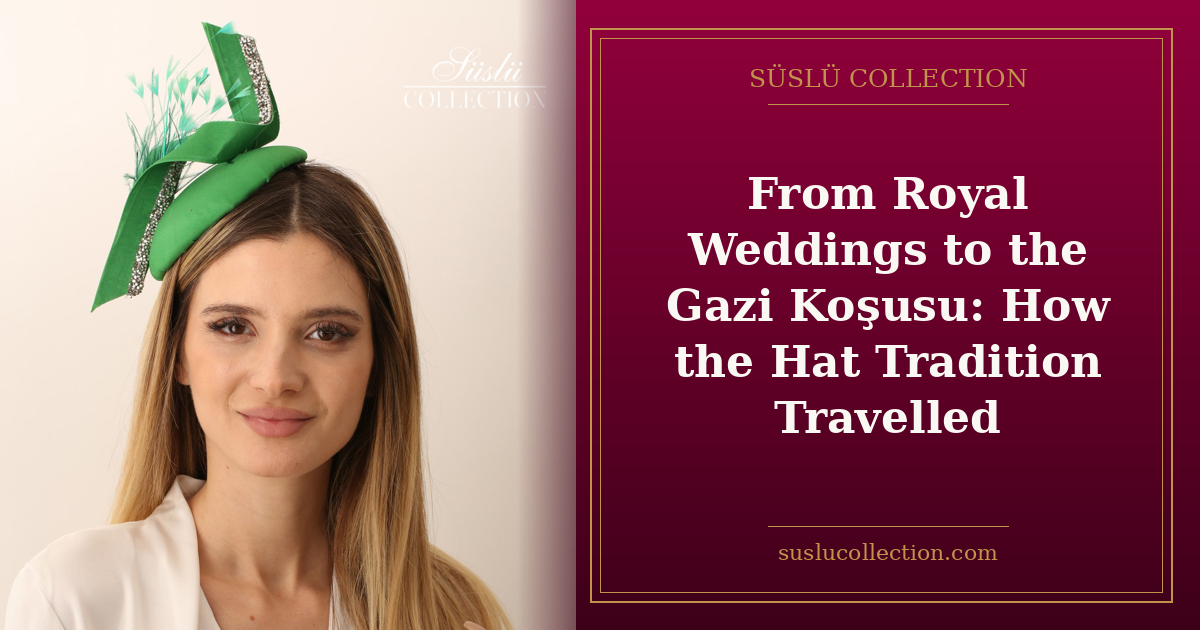
How did the same hat travel from royal chapel steps to a racecourse in Istanbul? Because occasion millinery is a travelling tradition — and racecourses are its summer palace. 🏇
The route runs in three stages: royal weddings set the protocol, Royal Ascot turned it festive, and the Gazi Koşusu gave it a Turkish home at Veliefendi.
This guide rides the route, contrasts the chapel and racecourse registers, and lands with field notes for your first race day — wedding hat welcome. ✨
Main guide: the wedding hat guide · the century behind it: the history story.
Stage one: royal weddings write the protocol
Every travelling tradition needs a cathedral, and occasion millinery’s is the royal wedding: the one event where guest hats are effectively dress code law. 👑
Watch any royal wedding broadcast and the lesson repeats: a sea of hats, each obeying the same quiet hierarchy.
Why do royal guests always wear hats?
Court protocol preserved what everyday fashion dropped: formal daytime events ask for a covered head. Royal weddings broadcast that rule to millions — free advertising no milliner could buy.
What did the broadcasts teach the world?
The full vocabulary: viewers met the pillbox, the fascinator and the statement brim by name and by face. Modern search interest in fascinators still spikes with every royal event.
How does the hierarchy work?
Rank wears scale: senior royals carry the boldest pieces, guests calibrate downward — the same one-notch-quieter logic every wedding uses, described in the church guide.
What crossed over to ordinary weddings?
Nearly everything: the guest fascinator habit, the mother’s veiled pillbox, the tonal palette discipline. Royal chapels are simply the tradition’s shop window.
Protocol set. Now the tradition goes outdoors — and gets playful. 🎪
Stage two: Ascot turns protocol into festival
Take the chapel’s hats, add sunshine, champagne and horses, and the register flips: at the races, millinery is the spectacle itself. The two-register table above draws the line. 🥂
Royal Ascot codified the flip: its enclosures publish hat rules the way weddings publish dress codes — but the rules ask for presence, not restraint.
What changes when the hat goes racing?
Permission: bold tones, sculptural shapes and playful trims move from risky to required. The racecourse is where the pieces too joyful for a chapel finally run free.
Why do racecourses suit millinery so well?
Geometry and light: open sky flatters brims, standing crowds view hats at full height, and photographs happen at distance — the exact conditions statement pieces are built for.
Does etiquette survive the party?
Absolutely, just re-tuned: sightline courtesy holds in the stands, and enclosure codes still grade formality by area. Festival is not anarchy; it is protocol smiling.
What is the “ladies’ day” phenomenon?
The tradition’s crescendo: one race day crowned for style, where hats headline the sports pages. Every major racing nation grew its own — which brings the route to Istanbul.
Stage two complete. The tradition boards a flight east. 🇹🇷
Stage three: the Gazi Koşusu adopts the ritual
Turkey’s greatest race has run since 1927 in Atatürk’s honour, and Veliefendi Racecourse hosts it each summer as the country’s Derby day. In recent years the stands have answered with the tradition’s full wardrobe. 🏆
The adoption is natural: a historic race, a summer date, an Istanbul crowd that dresses for occasions — every ingredient Ascot ever needed.
What is the Gazi Koşusu?
The Turkish Jockey Club’s flagship: three-year-old thoroughbreds over 2400 metres, the race every Turkish owner dreams of winning. Its prestige is exactly what gives the stands their dress-up licence.
How does Veliefendi wear the tradition?
Increasingly like its western cousins: elegant dresses, statement hats and fascinators fill the premium stands, and the day’s photographs read half sport, half style page.
Is a wedding hat at home there?
Perfectly — often better than at its own wedding: colour rules relax, netting reads playful, and the piece finally competes on its own merits. It is the flagship stop of the re-wear calendar.
When is race day?
High summer, at the season’s heart — which stacks it with wedding season: one reason convertible pieces earn their keep, as the seasonal guide notes.
The route is complete: chapel, Ascot, Veliefendi. Last chapter: your ticket in. 🎟️
Your first race day: the field notes applied
The five notes above come from customers who learned them the windy way; here is each note in working detail. 🌬️
The organising idea: a racecourse is an outdoor wedding with more wind and better light — every skill transfers.
How serious is the wind, really?
Co-host serious: open stands funnel gusts that lift unpinned brims like kites. The X-lock and extra pins from the hairstyle guide are not optional equipment here.
What does the sun change?
The afternoon: brims earn their architecture and lightly tinted netting doubles as the chicest sunshade in sport. Summer’s breathable weaves rule, exactly as the seasonal wheel predicts.
How does the wedding piece convert?
With one colour layer: a clip-on band, a bold flower, a tonal bow — the ivory keeper turns race-ready in minutes. The conversion is light bench work via the custom process or a request through contact.
What should a first-timer actually pack?
The featherweight option: a mid fascinator survives eight standing hours where crowns surrender by race four. The race-ready rail lives in the collection — filter for bold tones and clip mountings.
Route ridden, notes packed. The summary waits at the finish line. 🎀
🧵 Notes from the Atelier
The order that tells the story best: a bride’s ivory headpiece returns eleven months later for a burgundy band and a bolder flower — destination Veliefendi. The wedding-to-racecourse pipeline is real and growing. Second note: first-time racegoers always underestimate the wind and never twice; we now hand a spare pin set with every race-season purchase. Third: the Gazi Koşusu photographs that customers send back have become our favourite unofficial catalogue — sunlight is the brand’s best photographer.
📖 Quick Glossary
Enclosure: a racecourse’s graded seating area with its own dress code. Ladies’ day: the race day crowned for style. Thoroughbred classic: a flagship race for three-year-olds. Conversion layer: the clip-on colour that re-registers a wedding piece. X-lock: crossed pins over a comb — wind insurance.
⚡ Quick Summary
Occasion millinery travelled a three-stage route: royal weddings wrote the protocol, Royal Ascot turned it into festival, and Istanbul’s Gazi Koşusu gave it a Turkish summer home at Veliefendi. 🏇 The registers differ — chapel asks restraint, racecourse rewards spectacle — but every skill transfers. A wedding hat converts with one colour layer; wind planning and featherweight picks carry the long day.
🎯 Next Step
Book the second stage for your own piece: the race-ready rail is live in the collection — or send your wedding hat’s photo via contact for a conversion suggestion before the summer card fills.
Sıkça Sorulan Sorular
Why do people wear hats at horse races?
The habit travelled from royal wedding protocol through Royal Ascot, which turned formal head-covering into festive spectacle. Racecourses flatter hats: open light, standing crowds, distance photography.
What is the Gazi Koşusu and can I wear a hat there?
Turkey’s flagship thoroughbred race, run at Istanbul’s Veliefendi since 1927 in Atatürk’s honour — and yes: statement hats and fascinators increasingly define its premium stands.
Can I wear my wedding hat to the races?
Perfectly — add one colour layer, a clip-on band or bold flower, and pin against the wind. Race days are the flagship stop of a wedding hat’s second life.
Kaynak: Türkiye Jokey Kulübü — official site of Turkish racing and the Gazi Koşusu
Bridal Hats & Veils
Browse Products


