

Royal Christening Traditions: 160 Years of a Single Gown

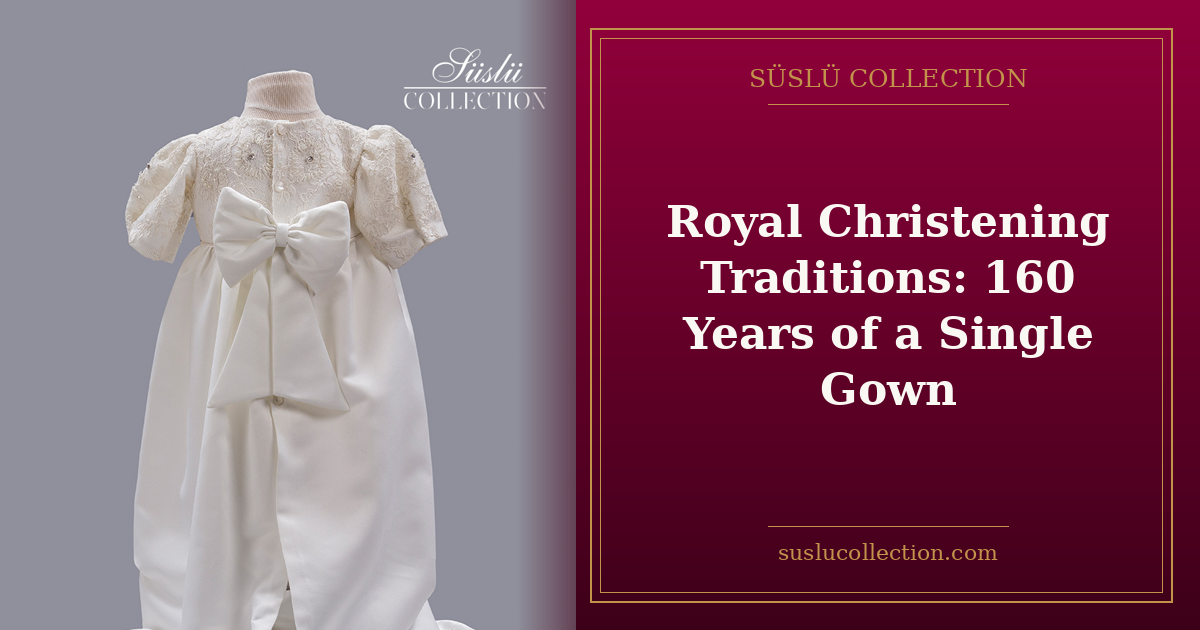
The world’s most famous christening gown was a single gown for 160 years. Royal christenings stage a simple truth this guide is about: the right gown can become generations’ shared memory. 👑
This guide tells the famous gown’s four-act story, draws six observations from royal frames, and converts the lesson into steps that work at home.
The aim is inspiration, not imitation: you will look not at the palace but at your own family register. ✨
Master guide: the christening outfit guide · the historical ground: the gown’s history.
Four acts: one gown’s 160 years
The strip summarised the story; this section opens the acts. The story’s power is its number: one gown, more than sixty babies — worldwide proof of the heirloom idea. 📜
And the story begins in the Victorian age: it is the brightest scene of the showcase era described in the history article.
What happened in 1841?
Queen Victoria commissioned, for her first daughter’s christening, a gown of Honiton lace with satin lining — the same lace school as her wedding dress. The garment was designed from birth as a family record.
How did it survive 160 years?
Through discipline: careful cleaning after every rite, dark and dry storage, limited wearing time. The endurance lay not in the fabric but in the care routine — the very lesson of the storage guide.
Why was a replica sewn in 2004?
The original had tired: the fabric grew too delicate to carry ceremony weight. An exact replica was made and the original placed under protection — the most mature decision in keeping an heirloom alive.
What does the gown do today?
Its duty: the replica gives the same frame to the new generation of royal babies. The tradition lives not in the garment but in the continuity — the replica proved it.
Do other royal houses run one gown too?
Mostly yes: the Spanish, Swedish and Danish courts also christen generations in a single family gown. The habit is a European language, independent of any crown.
Story told. Now the close reading: six observations. 🔍
Six observations from the royal frames
The list ordered six observations; this section enlarges four. Royal christening photographs are textbooks examined by millions: every detail is a conscious choice. 📸
The observations’ shared ground surprises: the palace plays by exactly the same rules as this guide set.
Why is the tone ecru-ivory?
Because the gown aged, and the warm tone settled into the family story: snow white speaks novelty, ecru speaks continuity. The tone language matches the map in the white article.
How is the waterfall frame built?
Lap + flowing hem + plain background: the royal photograph’s central scheme. The long hem’s stage power is in the length article; the scheme rebuilds in any living room.
Why is the family frame small?
For focus: the baby-parents-godparents core protects the frame from crowd noise. The wide family photo is taken separately — the centre frame stays plain.
The home lesson of the replica decision?
A tired heirloom is never forced: the delicate gown retires to box or display, and the story continues with a new piece. Wear management belongs to the reuse guide.
Observations logged. Next, the application table: palace lesson, home scale. 🏠
Palace lesson, home scale: four applications
The table paired the columns; this section builds the right column step by step. Good news: the royal tradition’s core costs not money but a decision. 🗝️
The four steps’ total price is one embroidery and one box; the return is a generations-long story.
How is “the family gown” declared?
In one sentence, at the first christening: “this gown stays with us.” Once said, the choice changes — heirloom-friendly cuts and repairable lace step forward; candidates stand flagged in the collection.
When does the register embroidery open?
With the first name: the baby’s name and date inside the hem, generations added below. The same logic as the Scandinavian register — the journey is in the custom guide.
How is the plain-background frame taken at home?
One wall + window light + the lap: three elements, the palace scheme’s home edition. Tell the photographer “centre frame, few people” — the rest arranges itself.
Is museum discipline possible in a home box?
Sufficiently: acid-free tissue, a dark-dry wardrobe, a yearly check. The full protocol is in the storage guide — the palace differs in scale, never in principle.
Applications built. Closing: the famous christenings’ invisible secret. 🤫
The invisible secret: planned simplicity
What makes royal christenings captivating is not splendour; it is planned simplicity: few colours, few people, one focus. This secret copies at any budget. 🕊️
And precisely for that reason, the guide’s ending leaves the palace and returns to your ceremony.
What does the few-colours principle mean?
The frame’s palette stays at three tones: the gown’s white, the parents’ neutrals, the background’s calm. Colour whispers in details — the rule matches the white article’s boundary section.
How is the single focus protected?
By accessory dose: bonnet-shawl-booties suffice, the rest waits in the box. The dose table is in the accessories guide.
How does the palace manage the rite’s rhythm?
By keeping it short: a core rite, planned frames, the feast kept apart. A baby’s rhythm outranks even royal protocol — nap time over crown time.
If one sentence remains from this guide?
Let it be this: tradition is not bought, it is begun — the first gown, the first stitch, the first box. For the family ready to begin, contact is two lines away.
The royal file closes: four acts, six observations, four applications, one secret. Summary below. 🎀
🧵 Notes from the Workshop
Families hearing the royal gown’s story always pause at the same place: “sixty babies?” — the number convinces in an instant where arguments take pages. Second note: the first families who adopted our “family gown declaration” now return for the second baby with alteration-plus-embroidery orders; the register genuinely runs. Third: the plain-background centre frame draws praise from photographers too — planned simplicity makes even an amateur frame look palatial.
📖 Quick Glossary
Honiton lace: the English handmade lace school of the famous gown. Replica gown: the exact continuation sewn in 2004. Centre frame: the small-cast main family photograph. Family-gown declaration: the decision fixing a gown as heirloom. Planned simplicity: the few-colours, few-people, one-focus order.
⚡ Quick Summary
The Honiton lace gown of 1841 dressed more than sixty royal babies across 160 years; when it tired in 2004, an exact replica took over. 👑 Six frame observations: the single-gown tradition, the ecru tone, the waterfall frame, the replica lesson, the small centre frame, museum discipline. The home scale is four steps: the family-gown declaration, register embroidery, the plain-background frame, the acid-free box. One secret over all: planned simplicity.
🎯 Next Step
Declare your own family gown today: heirloom-friendly models stand flagged in the collection — contact arranges the embroidery and the box routine.
Sıkça Sorulan Sorular
What is the story of the royal christening gown?
The Honiton lace gown Queen Victoria commissioned in 1841 dressed more than sixty royal babies over 160 years; when it grew delicate, an exact replica sewn in 2004 took over, and the tradition continues with it.
What lessons do royal christenings teach?
Six observations: the one-gown-all-generations tradition, the ecru tone’s language of continuity, the waterfall frame, protecting a tiring heirloom with a replica, the small plain centre frame, and museum-disciplined storage.
How can the royal tradition be applied at home?
Four steps: declare the first gown the family gown, open the register with name-date embroidery inside the hem, plan a plain-background small-cast centre frame, and run an acid-free box with a yearly check.


