

When to Prepare a Christening Outfit: The Countdown Guide

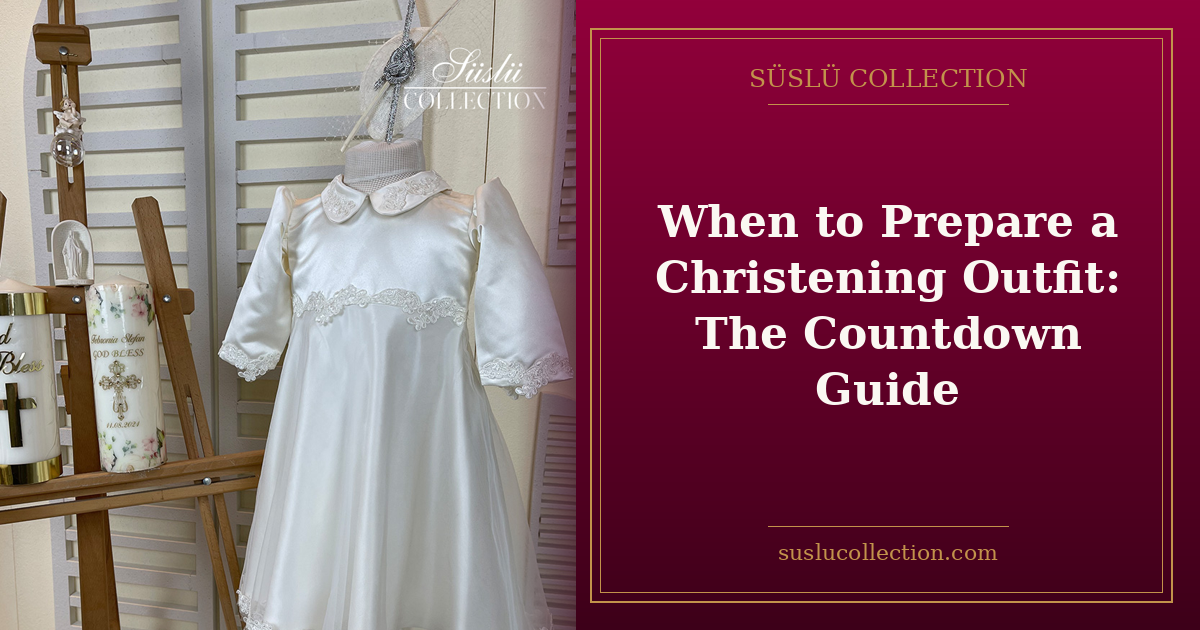
When should a christening outfit be prepared? One sentence: the box should be in hand and tried on one week before the ceremony — the whole calendar counts backwards from that target. ⏳
This guide builds the countdown strip, sets the early plan against the last-week scramble, and prices in the five factors that shift any calendar.
The calendar is not a stress tool; it is the stress eraser — built once, it runs itself. ✨
Master guide: the christening outfit guide · the buying side: where to buy.
The countdown: a six-stop strip
The strip divides preparation into six stops; this section explains their logic. One principle: every stop hands over cleanly to the next. 🗓️
The strip’s zero point is not the outfit but the date: no shopping step moves before the church confirmation lands.
Why church first, outfit second?
Because the date changes the size arithmetic: a ceremony two months out is measured with growth allowance, not today’s numbers. The conversation steps are in the venue guide.
At which stop are measurements taken?
Just before the order stop — measurements taken 2-3 weeks before delivery are the truest. Technique and allowance are in the sizing guide.
What happens at the one-week stop?
The triple check: tone in daylight, fitting on the baby, set match. If something fails, the exchange window is still open — procedure runs, not panic.
Why is ceremony week shopping-free?
Because that week belongs to the family: invitations, celebration, guest traffic. On the outfit front only the hanger-and-bag order remains; no decisions are left.
Strip built. Now the motivation chapter: what early buying actually buys. ⚖️
What does the early plan purchase?
The table compares two scenarios; the gap is not emotional but concrete: the early plan keeps four doors open — size, personalisation, cargo tolerance, a calm week. 🚪
The last-week scramble’s true cost is not money but choicelessness: whatever remains is what gets bought.
What is the size-confirmation door?
Send measurements, receive confirmation, place the order: the three-message routine works only when the calendar is wide. In the last week, confirmation gives way to guessing — the mother of exchange traffic.
Why does personalisation demand early?
Embroidery runs double-checked, tailoring runs on stations: both eat days. The station map is in the custom guide; the door stands open at 4-5 weeks out.
How does cargo tolerance work?
Through buffer days: an order placed two weeks out swallows a three-day delay unnoticed. The same delay on a last-week order means waiting for the doorbell on the ceremony morning.
Is a genuinely calm week possible?
Standard among calendar families: outfit in the wardrobe, plan in the pocket, week reserved for guests. Our sweetest workshop messages come from this week — “everything is ready, just thank you”.
Payoff clear. Next, the real-life tuning: five calendar-shifting factors. 🧮
Five factors: personalising your calendar
The standard strip fits everyone; five factors turn it into your calendar. The rule is plain: every applicable factor pulls its band earlier by the stated amount. 🔧
Factors stack: in the busy season, a family wanting custom plus embroidery reaches a six-week band comfortably.
Why does tailoring add 2-3 weeks?
Approved stations take time: proposal, sample, sewing, fitting. What is bought is not speed but precision; rushed tailoring works against both sides.
How is the busy season spotted?
By the calendar: spring-summer is the christening peak, filling workshop and cargo lanes. The season’s fabric side is in the season guide; its calendar side is this line.
What should international families do?
Enlarge the buffer: a week’s allowance for shipping and customs, and the fitting on the first day after arrival. The box can also route to a Türkiye address before travel — plan it via contact.
Why does heirloom work demand a survey before a promise?
Because fabric condition sets the time: sound lace is a day’s work, a worn panel a week’s. First the photographed survey, then the honest date — that order never flips.
Calendar personalised. Closing: an honest guide for the late. 🚨
An honest guide for the late
Life ignores calendars: dates move up, decisions lag. Being late is no crime; managing it badly is the problem. Three scenarios, three honest answers. 🕐
The shared principle: when late, the target shrinks — not the perfect set but the right size and a clean white.
The ten-days-out scenario?
Stock size from the ready collection plus fast shipping: still a comfortable window. Send measurements the same day, order with confirmation — the one-week check is still possible.
The five-days-out scenario?
Stock + express shipping + size confirmation by phone: embroidery and personalisation are closed in this window. Choosing accessories from a single set-product zeroes the tone risk.
The 48-hour scenario?
Honest answer: if stock and city align, it works; if not, we do not force it. Send the date and city — if it fits we plan, if not we name alternatives; selling hope is not this workshop’s trade.
How is lateness never repeated?
One habit: building this guide’s strip the day the date confirmation arrives. Second-time families do it unprompted — the calendar is the most lasting skill. Candidates wait around the clock in the collection.
The calendar file closes: strip, payoff, factors, rescue plan. Summary below. 🎀
🧵 Notes from the Workshop
Our inbox lives at both ends of the same week: “eight weeks out — too early?” and “the ceremony is Saturday — can it make it?” — the first gets “perfect timing”, the second gets the honest stock answer. Second note: families who run the one-week check request exchanges so rarely it rounds to never; the ten-minute session is the system’s heart. Third: every family we rescue from lateness writes eight weeks early for the next child — the calendar lesson’s sweetest proof.
📖 Quick Glossary
Countdown: the plan built backwards from the ceremony date. Buffer day: the shipping-delivery safety margin. Season peak: the spring-summer rush. Condition survey: the heirloom’s photographed pre-date inspection. Calm week: the shopping-free ceremony week.
⚡ Quick Summary
The target is fixed: box in hand and tried on one week before the ceremony. ⏳ The strip: church confirmation at 8 weeks, custom brief at 4-5, candidates at 3, order at 2, triple check at 1. Five factors shift bands: tailoring +2-3 weeks, embroidery +3-5 days, busy season -1 week, distant shipping +3-7 days, heirloom survey first. For the late: shrink the target and move on stock + confirmation + express.
🎯 Next Step
Write your ceremony date today via contact — your personal countdown strip built in one message; browsing starts any time in the collection.
Sıkça Sorulan Sorular
When should a christening outfit be prepared?
The box should be in hand and tried on one week before the ceremony: ready-made orders go in two weeks out, custom briefs four to five weeks out. In the busy spring-summer season every band moves a week earlier.
What is the first step of christening preparation?
The church conversation and date confirmation: the whole calendar counts backwards from that date. No measurement or order moves before it; measurements are taken 2-3 weeks before delivery.
Can an outfit still make it on short notice?
Ten days out, comfortably (stock plus fast shipping); five days out, with confirmed stock; at 48 hours, only if stock and city align. Embroidery closes in the late window; the target shrinks to right size and clean white.
Kaynak: Wikipedia — Time management


