

Mother-Daughter Matching Dresses: A 2026 Harmony Guide
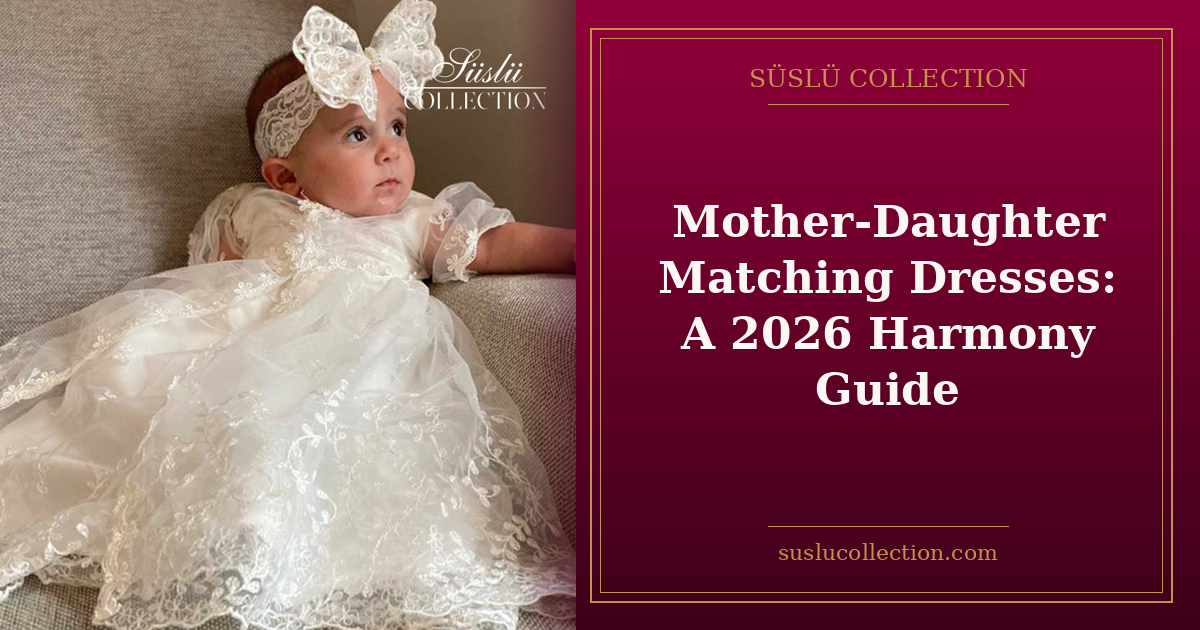
How do you create mother-daughter matching dresses? Short answer: choose one of four levels — the same colour, the same fabric, the same detail or an identical model; at every level the child stays in a cut suited to her age. 👩👧
This piece covers the four levels of harmony, the difference between identical and coordinated sets, and the five steps of a mother-daughter set.
Mother-daughter matching is 2026’s best-loved family photo setup: not a dress, but a keepsake plan. ✨
Main guide: girls’ occasion dresses · the tailoring decision: custom or ready-made.
The four levels of harmony
The list set out the levels; this section explains whom and which occasion each suits. The levels run from a whisper to a loud voice: same colour is the subtlest, identical the strongest. 🎚️
No level beats another; the choice follows the family and the occasion.
Why is the same colour family the easiest?
It can be built with ready-made dresses: mum in a navy midi, daughter in a navy lace-collared dress — different models, same tone. The harmony shows instantly in photos, and nobody looks “in costume”.
What does the same fabric add?
A textural bond: the same burgundy velvet or blush shantung in different cuts. It needs custom-making or an atelier’s mother-and-child collection.
What does the same detail mean?
A hidden signature: the lace on mum’s collar repeated on her daughter’s, or the same satin sash on both dresses. An elegant bond noticed up close.
An identical model?
The strongest effect: two sizes, one design. Very sweet at younger ages and the star of the photo on special days. It requires custom-making.
How do dad and a brother join in?
With a tie, bow tie, pocket square or waistcoat in the same colour family: the family photo is complete, and nobody looks overly costumed.
The levels are known. Now the big decision. ⚖️
Identical or coordinated?
The table compared the two approaches; this section explains how age and occasion shape the decision. The deciding factor is usually the child’s age: a two-year-old loves the twin look, a twelve-year-old wants her own style. 🪞
Deciding together means two happy faces in the photo.
At what age is identical loveliest?
Between 2 and 7: the child loves copying mum, and “the same as mummy” is a proud sentence. Ideal for birthdays and family photo shoots.
What changes at the young-lady threshold?
At 8-12 a child searches for her own identity: an identical dress can feel “babyish”. The same-fabric or same-detail level suits this age better.
Should the cut be the same?
No: mum’s cut is adult, the daughter’s a child’s cut. Even in an identical model, the child’s version is shorter, more comfortable and with volume adjusted for her age.
Which occasion suits which?
Family photo shoots and birthdays can carry identical sets; at weddings and mevlids a coordinated set looks more elegant — it never upstages the bride or the day’s owner.
Can mother and daughter wear white to a wedding?
No: as guests, white belongs to the bride. Colour rules are in the wedding guest piece.
The decision is clear. Next, the steps. 🪜
Five steps of a mother-daughter set
The strip gave the steps; this section explains each one’s trick. A set is a project: two sizes, sometimes two dresses to sew, one calendar. 📅
Families who follow the steps find both dresses ready on the morning of the event.
Why is the occasion first?
The occasion sets the harmony level: a family photo asks for strong harmony, a wedding for subtle. Fabric and model aren’t chosen until the occasion is clear.
Why ask her?
Because she’ll carry the set too: over age 7, the child’s view is decisive. Looking through options together is the most enjoyable part of the set.
How are cuts separated by age?
Mum in a midi and straight cut, daughter in an A-line or full skirt: the same fabric and tone speak in two different voices. The age steps are in the main guide.
Why is the calendar longer?
With custom-making, two dresses are sewn: planning 4-5 weeks is safe. If the same colour family is built with ready-made dresses, two weeks is enough.
How is the try-on done?
Both together, in daylight: stepping into the same photo and comparing tones reveals any on-screen difference. The play test (run, sit, hug) is done separately for the child.
The steps are done. Last section: 2026 and beyond. 🔮
2026 and beyond: the future of harmony
Mother-daughter matching may look like a fashion wave, but its roots are old: dresses sewn from the same fabric in family photos go back generations. This section explains today’s and tomorrow’s direction. 🌱
Three trends stand out: subtlety, natural fabrics and keepsake value.
Why is subtle harmony rising?
Families are moving away from the costume look: instead of identical sets, the same tone or the same detail is chosen more and more. There’s harmony in the photo, yet nobody looks like a “twin”.
Demand for natural fabrics?
Cotton, linen blends, silk shantung: comfort and a timeless look for both mother and child. Fabric characters are in the fabric guide.
How is keepsake value added?
The same date embroidered on the inside hem of both dresses: years later, two dresses coming out of a box tell the story of the same day. Embroidery options in the custom-made piece.
If siblings join too?
Graded harmony: from the same fabric, an age-appropriate model for each child and an adult cut for mum — the loveliest family photo setup.
How do you begin?
One message: the occasion, date, the child’s age and the harmony level you want, sent via contact — a recommendation the same day. Children’s models are in the girls’ dresses collection.
The matching file closes: levels, decision, steps, future. Summary below. 🎀
🧵 Notes from the Atelier
With mother-daughter requests, the most chosen level is “same fabric, different cut” — elegant and suited to every age. Second note: in photos from families who choose together with the child, both faces smile with the same happiness. Third note: requests for the same date embroidered on both dresses keep growing; two dresses coming out of a box together become one of a family’s favourite keepsakes.
📖 Quick Glossary
Identical (twinning): mother and daughter in the same model. Coordinated set: same tone or fabric, different model. Hidden signature: a small detail shared by both dresses. Graded harmony: different models for different ages from the same fabric.
⚡ Quick Summary
Four levels of harmony: same colour, same fabric, same detail, identical model. 👩👧 Identical sets are loved at 2-7; at 8-12 the same fabric or detail suits better; the cut is always separated by age. Coordinated at weddings, identical at birthdays and family shoots. Four to five weeks for custom-making, two weeks with ready-made dresses.
🎯 Next Step
Write the occasion, date, age and harmony level via contact — a recommendation the same day; models in the girls’ dresses collection.
Sıkça Sorulan Sorular
How do you create mother-daughter matching dresses?
Choose one of four levels: the same colour family (different models), the same fabric (different cuts), the same detail (shared lace, sash or bow) or an identical model. At every level the child’s dress stays in a cut suited to her age.
Until what age do mother and daughter wear identical dresses?
Identical models are loved most between ages 2 and 7. At 8-12 a child looks for her own style, so the same-fabric or same-detail level is usually better received. Deciding together with the child is recommended.
When should mother-daughter dresses be ordered?
With custom-making, 4-5 weeks before the event, because two dresses are sewn. For sets built from ready-made dresses in the same colour family, two weeks is enough. Trying both dresses on together in daylight reveals any tone difference in advance.
Kaynak: Wikipedia — Fashion
Girls' Occasion Dresses
Browse Products


