

What to Put in a Christening Keepsake Box: A Three-Layer List
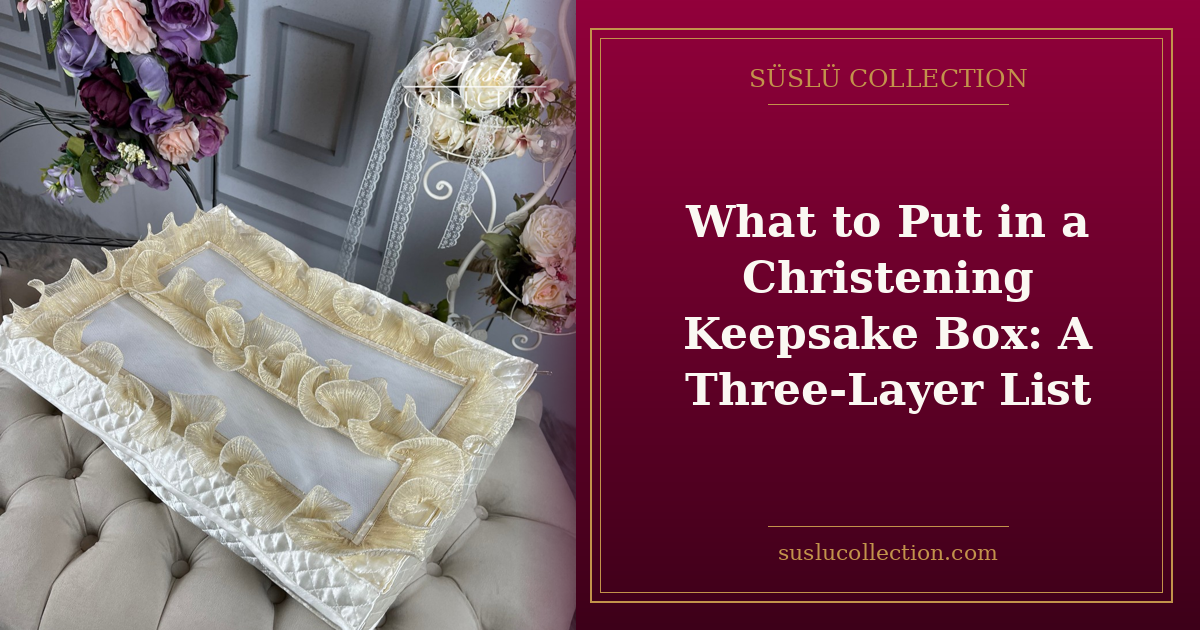
What goes inside a christening keepsake box? Short answer: three layers — the ceremony outfit at the bottom, accessories in the middle, keepsakes on top; acid-free paper in between, and anything that holds moisture stays out. 📦
This piece covers the layers one by one, what should never go in, and how to fill the box in the right order.
A well-filled box keeps its first-day order even when opened years later: every piece in place, no fabric yellowed. ✨
Main guide: christening keepsake box guide · accessory list: christening accessories.
Three layers: outfit, accessories, keepsakes
The list set out the layers; this section opens what each holds and why it sits where it does. The logic is simple: heavy and large at the bottom, small and delicate on top. 🗂️
This order keeps the outfit from being crushed and tells a story in the right sequence to whoever opens the box.
What’s in the outfit layer?
The christening gown or suit, the bodysuit or vest worn underneath, socks and booties. Long christening gowns settle in two or three folds; rolled acid-free paper goes into the folds.
What’s in the accessory layer?
Bonnet or hat, the ceremony towel, the christening candle, ribbons, a small cross or medallion necklace. Jewellery goes into separate small pouches so it leaves no mark on the fabric.
What’s in the keepsake layer?
The ceremony invitation, a copy of the christening certificate, a photo from the day, a short note from the godparents or grandmother. All in a single envelope, on top.
How is the bonnet placed?
Lightly stuffed with acid-free paper: it keeps its shape and isn’t crushed. Lace or tulle around its edges faces upward.
Does the candle go in?
It does, but wrapped in paper in its own pouch: wax can soften with heat and leave grease on fabric. In a warm cupboard it should never touch the textiles.
How are the booties kept?
Stuffed with paper and kept as a pair in a pouch: being small, they’re the pieces most likely to go missing.
The layers are done. Now the “never” list. 🚫
What goes in, and what never does?
The table set the two lists side by side; this section explains the “never” list. The box’s enemies are clear: moisture, acid, dye and metal. 🧪
A box that keeps these four out brings out a clean outfit even twenty years later.
Why are plastic bags banned?
Because they don’t breathe: trapped moisture turns into mildew spots and yellowing. The outfit is always protected with cotton pouches or acid-free paper.
Why no perfume?
Its alcohol and oils leave yellow stains on fabric over time. One drop added “so it smells nice” can become a mark that never comes out years later.
Can flowers go in?
Never fresh ones: they rot and leave colour. If fully dried flowers are included, they sit in a separate paper envelope, away from the outfit.
What do metal pieces do?
Paper clips, safety pins and metal buckles rust with moisture and leave brown marks on fabric. Papers are kept unstapled, the outfit pin-free.
Are mothballs needed?
No: their smell soaks into fabric and isn’t suitable for baby things. In clean, dry fabric the moth risk is low anyway; lavender sachets can be used without touching the fabric.
Does jewellery go in?
A separate jewellery box is safer for valuable pieces; only the small symbolic piece worn on the day stays in the keepsake box.
The list is done. Next, the filling order. 🔢
Five steps to filling the box
The strip listed the steps; this section gives each one’s trick. The most important rule: don’t close the box on the evening of the ceremony — the outfit needs air first. ⏱️
The five steps take half an hour; the reward is an order that lasts for years.
How is the outfit prepared?
After the ceremony it’s aired on a hanger overnight; any milk, food or oil stain goes to professional cleaning right away. Invisible sugar stains yellow over the years.
How is it folded?
With acid-free paper, without sharp creases: rolled paper goes into the folds. Lace and embroidered sections face inward, not outward.
How is the bottom layer laid?
The outfit is spread flat and relaxed across the base of the box; a sheet of acid-free paper goes on top.
How are accessories placed?
Each in its own cotton pouch, spread evenly over the outfit: weight isn’t concentrated in one spot.
Why is the keepsake envelope on top?
It’s the first thing to greet whoever opens the box: a photo and a few lines of a note tell the story of what’s inside. Writing the date on the envelope helps.
Filling is done. Last section: yearly care. 🗓️
Yearly care and common situations
Even after the box is closed, it needs attention once a year. This section covers yearly care and the three situations families meet most often. 🔍
Ten minutes a year protects a twenty-year memory.
How is the yearly check done?
On a dry day the box is opened, the outfit briefly aired and refolded along different lines. This prevents permanent fold marks. Storage principles are in the christening gown storage piece.
What if a yellow stain appears?
Don’t treat it at home with bleach: lace and satin get damaged. Consulting a cleaner experienced with heirloom textiles is best.
Can pieces be added later?
They can: first-birthday booties, a first-tooth box, a first drawing. Over time the box becomes a small archive of the child’s early years — as long as the lid still closes comfortably.
Where should the box live?
In a cupboard away from sunlight with low humidity, lying flat: basements and attics aren’t suitable. Details in the next generation piece.
Where to find a box of the right size?
Models to suit the outfit’s length are in the keepsake box collection; write via contact for size and embroidery.
The contents file closes: layers, bans, order, care. Summary below. 🎀
🧵 Notes from the Atelier
The one-page note we give families with each box always starts with the same three words: air, paper, lid. Second note: families who put a short letter in the keepsake envelope tell us their children cried most at that letter when they opened the box years later. Third note: almost every missing piece is a bootie — a small pouch ends that problem completely.
📖 Quick Glossary
Keepsake envelope: the envelope holding invitation, certificate and photo. Acid-free paper: paper that keeps fabric from yellowing. Cotton pouch: a breathable bag for small accessories. Rolled paper: paper placed in folds to prevent crease marks.
⚡ Quick Summary
Three layers go in: outfit at the bottom, accessories in the middle, keepsake envelope on top; acid-free paper in between. 📦 Plastic bags, perfume, fresh flowers, metal clips and mothballs stay out. After the ceremony, air the outfit and check for stains, then fold it with paper. Once a year, open the box and change the fold lines.
🎯 Next Step
For a box to suit your outfit’s size, write via contact; models in the keepsake box collection.
Sıkça Sorulan Sorular
What goes into a christening keepsake box?
At the bottom the christening outfit, underlayer, socks and booties; in the middle accessories such as the bonnet or hat, towel, candle, ribbons and small necklace; on top a keepsake envelope with the invitation, christening certificate, photo and notes. Acid-free paper goes between layers.
What should not go into the box?
Plastic bags (trap moisture), perfume and cologne (leave yellow stains), fresh flowers (rot and leave colour), metal clips and pins (leave rust marks) and mothballs (the smell soaks in).
Does the outfit go into the box on the ceremony day?
No. The outfit is first aired on a hanger overnight, checked for stains and cleaned if needed. Once it’s completely dry it’s folded with acid-free paper and placed in the box.
Kaynak: Wikipedia — Baptism
Christening Keepsake Box
Browse Products


