

Christening Outfit Trends 2026: The Year of Returning to Less

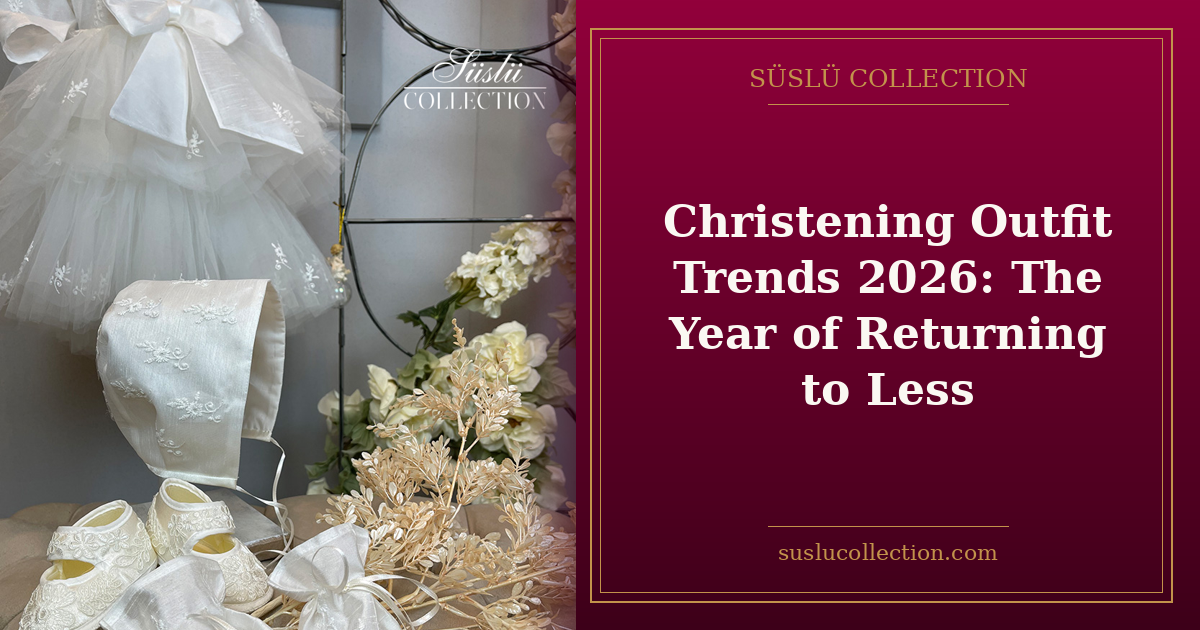
What changes in christening wear in 2026? Short answer: display shrinks, meaning grows — the year’s currents gather under “quiet luxury” and the heirloom wave. 🔮
This guide reads the six currents, sorts trend from classic in one table, and hands over the four steps of using trends wisely.
The principle up front: a trend is polish applied over the classic — it never replaces the base. ✨
Master guide: the christening outfit guide · the classic beneath: the model map.
Six currents: the photograph of 2026
The list took the year’s photograph; this section enlarges four currents. The shared direction is unmistakable: 2026 is the year of returning to less — fewer motifs, less synthetic, less noise. 📉➡️📈
The turn’s engine is the album: families now choose the frame with the eyes of fifty years hence.
How does quiet luxury look at a christening?
In quality: motifs decrease, stitching and fabric rise — plain from afar, flawless up close. Craft replaces display; lace speaks without shouting.
Why is the heirloom wave growing?
The royal effect plus the longing for family records: as the “one gown, all generations” story spread, the shopping question changed. The wave’s origin is in the royal article, its road map in the reuse guide.
What does natural fibre’s return bring?
Cotton-linen forward, shiny synthetics back: for the baby’s skin and the fifty-year endurance alike. The fabric-season pairing is in the season guide.
Whose solution are hybrid models?
Moving babies’: romper-gown cuts are the 9-14 month band’s practical answer. Their place in the family is in the model guide.
Where does the plain stage current feed from?
From royal frames and album awareness: the few-colours, few-people, one-focus language is spreading fast.
Photograph taken. Now the critical skill: sorting trend from classic. ⚖️
The trend-classic test: where the money goes
The table split two columns; this section gives the split’s logic. One question decides: is this feature still meaningful in fifty years? Yes → classic; no → passing. 🧪
The money rule flows from it: the budget invests in the classic, the trend is tried with small change.
Why does natural fibre sit in the classic column?
Because it passes three exams at once: skin-friendly, season-fit, heirloom-durable. Fibre is not a trend but a return — to the tradition’s original.
Why do stones and sequins sit in the passing column?
They fail the fifty-year test: sparkle pleases the season’s eye and looks dated to the next generation’s. Stones also raise a baby-safety question of their own.
How is the social-media aesthetic managed?
Confined to its frame: the themed corner, balloons and letter boards live at the feast; the gown and centre frame stay plain. The stage-feast split is the traditions article’s fourth inspiration.
Which column holds embroidery, and why?
The classic — a rising classic: name-date stitching never ages, being the register tradition’s continuation. 2026’s most accurate purchase is one line of embroidery.
Test learned. Next, the application: four-step trend use. 🛠️
Four steps: turning trend into polish
The strip gave four steps; this section ties each to the buying moment. The method’s core: classic body, trend detail — base fixed, polish free. 🎨
The steps run in order: base first, polish second — the reverse order carries the trend into the body and turns into an expensive mistake.
What does the classic base look for in a shop?
The trio: white-family tone, natural fibre, clean cut. This trio is the collection’s backbone, valid every year regardless of trend.
How large is the detail budget?
Small: ribbon colour, an embroidery line, the band choice — symbolic beside the body’s price. Trend appetite lives safely in this line.
How is the fifty-year test run in practice?
One question at the decision moment: “what would my grandchild say to this frame?” A smile → proceed; a raised eyebrow → the detail simplifies.
Which decision keeps the heirloom door open?
Cut and fabric: loose cut + repairable lace + natural fibre. With that trio chosen, today’s trend gown is tomorrow’s heirloom — questions go to contact.
Method built. Closing: a short horizon tour toward 2027. 🔭
Horizon tour: looking past 2026
A trend guide’s debt of honesty: currents change. This closing reads the change’s direction — not prophecy, but a map of preparedness. 🧭
Three directions already show; all three strengthen this guide’s rules.
Where is personalisation heading?
Deeper: from name-date to family motifs, from one line to fabric stories. Embroidery registers will thicken — the door is in the custom guide.
How will sustainability reach christenings?
Through the heirloom’s rediscovery: the “one gown, many rites” order answers both heart and planet. The reuse culture will grow — preparation in the reuse guide.
Which way is ceremony scale drifting?
Smaller and deeper: fewer guests, planned frames, stronger gestures. Planned simplicity looks less like passing fashion and more like a settling language.
One note for the shop from this tour?
This: whichever way the wind turns, the classic base wins — white family, natural fibre, clean cut, register embroidery. A family choosing that quartet today stands ahead of every trend; candidates in the collection.
The trend file closes: six currents, one test, four steps, a horizon. Summary below. 🎀
🧵 Notes from the Workshop
2026 as seen from the bench: embroidery demand multiplies every season — “can a name be stitched too?” now opens the order messages. Second note: stone-and-sequin requests dissolve at the fitting; we ask the family the fifty-year question and the answer is always simplification. Third: the quiet-luxury wave made our craft story easier to tell — quality visible up close is the year’s most repeated sentence.
📖 Quick Glossary
Quiet luxury: unshowy, craft-first quality language. Fifty-year test: judging a choice with the next generation’s eyes. Polish principle: trends living only in details. Hybrid model: the romper-gown cut. Heirloom wave: choosing the gown as a generational asset.
⚡ Quick Summary
2026 turns toward less: quiet luxury, the heirloom wave, natural fibre, personal embroidery, hybrid cuts, the plain stage. 🔮 The trend-classic test is one question: meaningful in fifty years? Budget goes to the classic (white family + natural fibre + clean cut), appetite to details (ribbon, stitch, band). On the horizon: deepening personalisation, a growing heirloom culture, and ceremonies that shrink and deepen — the classic base wins every scenario.
🎯 Next Step
Fix your classic base today: browse the natural-fibre models in the collection — and plan your embroidery line via contact.
Sıkça Sorulan Sorular
What are the christening outfit trends for 2026?
Six currents lead: quiet luxury (few motifs, flawless craft), the heirloom wave, natural fibre’s return, name-date embroidery becoming standard, romper-gown hybrid cuts, and the plain-stage order.
How should trends be used in a christening outfit?
By the polish principle: the classic base (white family, natural fibre, clean cut) stays fixed while trends live only in details — ribbon, an embroidery line, the band choice. Budget goes to the classic, appetite to the small line.
Which christening trends are lasting?
Those passing the fifty-year test: natural fibre, name-date embroidery, heirloom-friendly cuts and the white base. Stones and sequins, theme costuming and momentary social-media aesthetics leave with the season.
Kaynak: Wikipedia — Fashion


