

Handmade Production: Five Stops in the Atelier
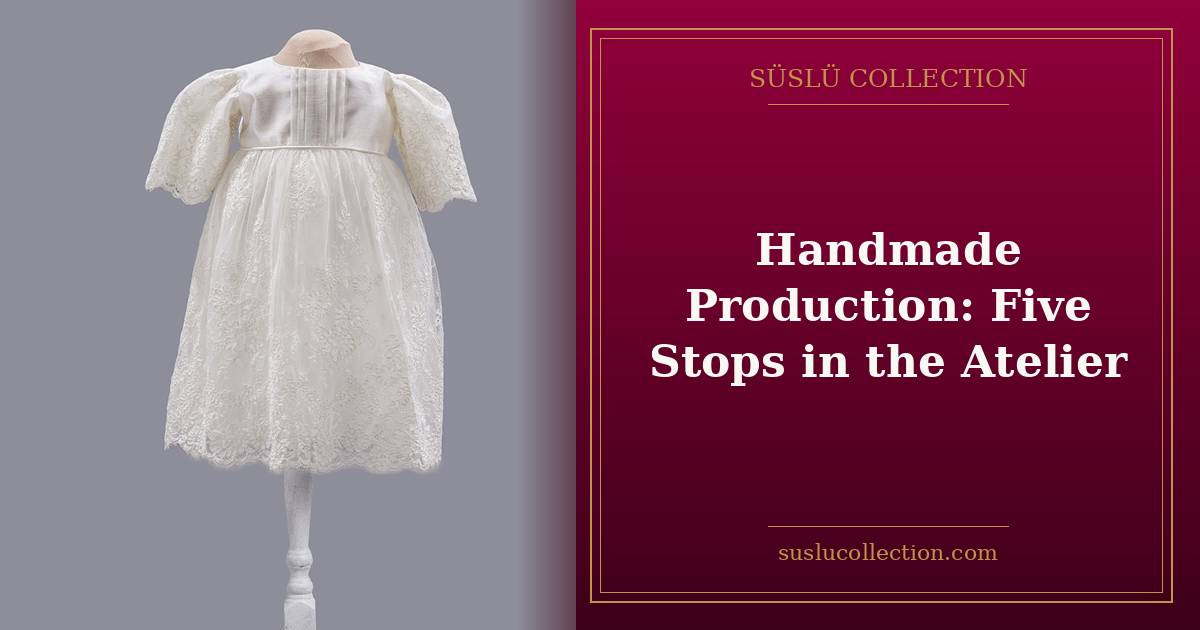
How are Süslü Collection pieces made? Short answer: in the atelier, through five stops and largely by hand — pattern, cutting, sewing, trimming and final check; every piece is prepared one by one, which is why no two are exactly identical. 🪡
This piece covers the five stops in the atelier, the difference between handwork and series production, and the traces handwork leaves in a garment.
Handwork isn’t a slogan but something you see from the inside: stitching, lining, edges and trims. ✨
Main guide: Süslü Collection brand · order process: how to place a custom order.
Five stops in the atelier
The strip drew the stops; this section explains what happens at each. The order never changes: paper to fabric, fabric to trim. 🧵
Ready-made pieces follow the same road; the difference is whether the pattern is drawn for one child.
How is the pattern drawn?
Measurements are carried onto paper: height, chest, waist and skirt length. In a custom order the pattern is drawn for that child; for ready-made, a pattern prepared to the size chart is used.
Why is cutting done by hand?
Slippery fabrics like lace and tulle shift under a machine: cutting by hand makes the motif land where it should. Whether a lace motif sits exactly at the centre of a neckline is decided here.
What matters in sewing?
Joining the body and setting the lining: as the layer touching skin, the lining must be smooth. Seam allowances are cleaned and thread ends trimmed.
What happens at the trimming stage?
Lace appliqué, embroidery, bows, pearls and sequins: all placed and stitched by hand. This is the longest stage.
What does the final check cover?
Pressing, thread trimming, measurement confirmation and a daylight photo: the piece ships once you approve it.
Where does the fabric come from?
Fabric and lace choice sets a piece’s character: satin, shantung, velvet and tulle come from different suppliers, and every batch is checked under light before cutting.
The stops are explained. Now the comparison. ⚖️
Handwork and series production
The table set the two methods side by side; this section opens the difference. Both are needed: the difference is scale and personality. 🏭
Series production isn’t bad; it just doesn’t give what handwork gives in a special-day piece.
What does scale change?
In series production thousands come from one pattern; in handwork each piece is its own work order. That lengthens time but raises fit.
Colour and fabric choice?
Series production works with colours set by season; handwork with the tone and fabric a family asks for. Requests like mother-daughter matching are only met this way.
How does trimming differ?
Machine embroidery is fast and even, hand embroidery more raised and alive. The two can be combined: machine on the body, handwork at the neckline.
What about durability?
Trims stitched one by one don’t come off; glued applications are damaged in the first wash. Quality signs in the why handmade piece.
Where does the price difference come from?
From time: the hours spent on a piece make up most of the price. Fabric comes second.
Can the two be used together?
Often: the body is sewn in series and the neckline, sleeves and hem finished by hand. Time shortens while the visible parts stay handworked.
The difference is clear. Next, the traces. 🔍
Four visible traces of handwork
The list set out the traces; this section says where to look. The rule: turn the piece inside out — quality hides on the inside. 🧐
These four checks apply to any brand and take a minute before buying.
What to look for in stitching?
Straight, close stitching, trimmed thread ends and tidy joins: in a rushed piece this shows first.
How do you judge the lining?
By hand: soft, light-coloured cotton lining that doesn’t run is essential in baby and children’s pieces. If the product page doesn’t state it, ask.
Why do edges matter?
Lace and tulle edges must be finished: a raw cut edge frays within a few wears and ages the piece.
How are trims checked?
With a gentle pull: pearls and sequins stitched one by one stay put. In small children’s pieces this is a safety check.
Pressing and packing?
A piece should arrive pressed, with soft fold lines and protected by paper: packing is part of the workmanship too.
What if a measurement is off?
Small differences can be corrected in the atelier: waist, sleeve and hem are adjustable on most pieces. This is why we suggest trying the garment the day it arrives.
The traces are explained. Last section: care. 🧺
Caring for a handmade piece
With the right care, a handmade piece passes to another generation. This section gives four care rules. 🧺
The rule is simple: low heat, gentle handling, breathable storage.
How should it be washed?
Lace, tulle and satin by hand in cold water without rubbing; velvet and silk shantung to dry cleaning. Cotton pieces at 30 degrees, turned inside out.
Ironing rule?
Inside out at low heat with a thin cloth between: tulle melts at high heat, velvet isn’t ironed but refreshed with steam.
How should it be stored?
Somewhere dark, dry and breathable, with acid-free paper or in a cotton bag: a plastic bag traps moisture. Detail in the storage piece, and its box in the keepsake box guide.
Is repair possible?
It is: a loosened lace or trim can be renewed in the atelier. That is the advantage of a handmade piece — it can be mended.
Where to begin?
Write your product and measurement questions via contact — an answer the same day; products in collections.
The production file closes: stops, comparison, traces, care. Summary below. 🎀
🧵 Notes from the Atelier
The longest stage is almost always trimming: placing a lace neckline by hand takes longer than sewing it. Second note: we tell customers to turn a piece inside out and look at the inner seams — the most honest test for our own pieces too. Third note: families who come back years later to have a lace renewed remind us of the best part of this work.
📖 Quick Glossary
Pattern: the paper template drawn from measurements. Appliqué: a trim cut and stitched onto fabric. Seam allowance: the extra fabric left for joining and altering. Inside: the reverse of a piece, where quality shows.
⚡ Quick Summary
Production runs through five stops: pattern, cutting, sewing, trimming, final check. 🪡 In handwork each piece is prepared one by one, with colour, measurements and trim following the order. Handwork’s traces show in stitching, lining, edge finishes and the firmness of trims. Care: cold water by hand, low-heat ironing inside out, storage with acid-free paper.
🎯 Next Step
Write your product and measurement questions via contact — an answer the same day; products in collections.
Sıkça Sorulan Sorular
Are Süslü Collection pieces handmade?
Most pieces are prepared one by one in the atelier: drawing the pattern, cutting, sewing and applying lace, embroidery and pearls are done by hand. That is why no two pieces are exactly identical.
How do you tell a handmade piece from series production?
By the neatness of the stitching, a cotton lining, finished lace and tulle edges and trims stitched one by one. Turning the piece inside out is the quickest check.
How long does a made-to-order dress take?
It depends on the model and the trimming: simple models take a few days, heavily laced and embroidered ones can take weeks. That is why a three-to-four-week window is asked for made-to-order pieces.
Kaynak: Wikipedia — Dressmaker
About Süslü Collection
Browse Products


