

Puffy or Simple Flower Girl Dress? The Layer Answer

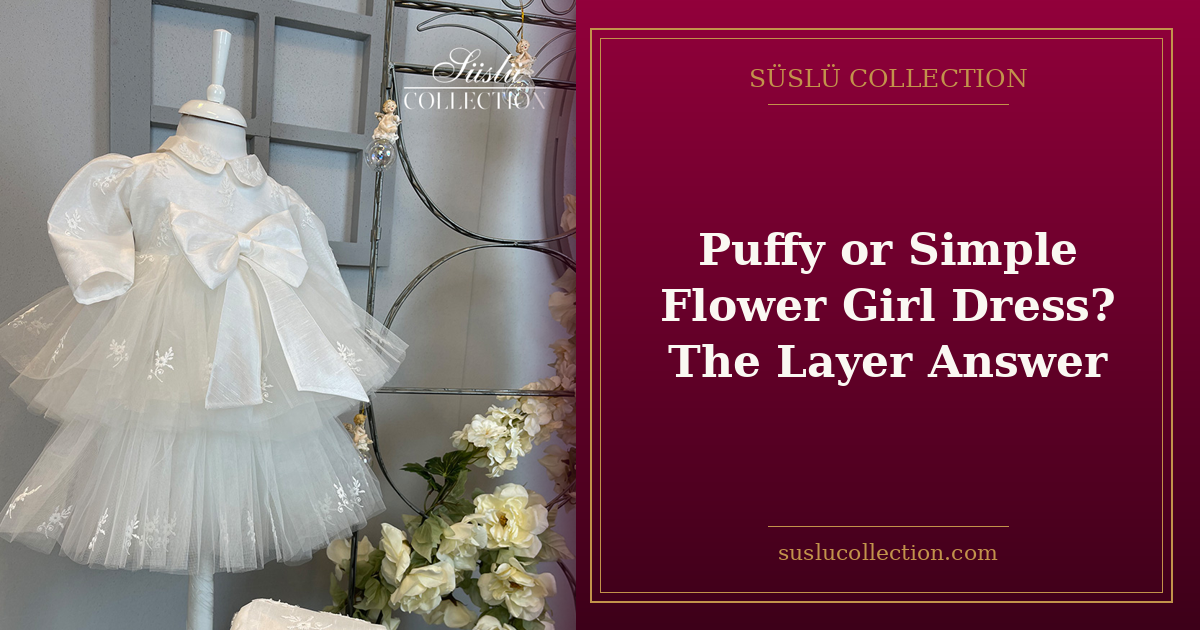
Should a flower girl dress be puffy or simple? Short answer: read the child and test the layers — volume delights the 3-6 dreamer when it comes from soft tulle sheets, the calm line frees the runner; the dance test referees both. 💃
This guide opens the layer skeleton, weighs the two silhouettes on a child-first scale, and runs the five-point dance test step by step.
One physics lesson up front: good volume is engineered lightness — many thin layers, never one heavy cage. ✨
Main guide: flower girl dress guide · styles map: styles by age.
The layer skeleton: where comfort is built
The list stacked the layers; this section explains the order. The skeleton is the guide’s quiet doctrine: comfort is engineered inside, beauty rides outside — reverse the order and the child suffers for the photo. 🧵
Every question about puffiness is really a question about this stack.
Why does cotton lining come first?
Because skin decides the day: cotton breathes, manages summer warmth and keeps every scratchy layer at a distance — the itch scan exists to confirm this layer did its job.
What does the petticoat actually do?
It holds the shape so the tulle doesn’t have to: a soft petticoat carries the silhouette, letting the tulle stay light and airy — shape from structure, not from weight.
How is volume kept light?
By sheets, not slabs: five whisper-thin tulle layers outperform one stiff one in both look and comfort — light layers move like water in a spin and collapse harmlessly in a hug.
What is the soft-circle rule?
The wire ban: hoops and boning belong to costume shops, not to children — a soft circle bends on a lap, in a car seat, on a climbing frame, and springs back for the camera.
Skeleton opened. Now the scale. ⚖️
The child-first scale
The table set the weights; this section reads them by child, because the honest question is never the catalogue’s — it is “which dress will she still love at hour five?” 🕐
Both silhouettes photograph beautifully; the difference lives in the wearing.
Who gets full value from volume?
The mirror-spinner: the 3-6 window loves volume with its whole heart, and a soft-circle skirt returns the love — every turn is a flower opening, every photo a small theatre.
Who is freed by the calm line?
The runner and the young lady: an A-line at half the weight carries a child who plans to move — and calms naturally into the 7-12 threshold’s grace, where puff gives way to line.
Does the venue tip the scale?
Firmly: a summer garden votes for lightness and breathing fabric, a winter hall forgives weight, a windy waterfront asks the skirt to behave — venue textures are read in the venue guide.
Is there a middle answer?
The half-layer: a lightly petticoated A-line gives volume’s silhouette at calm’s weight — the rising favourite of the 5-7 band and of the whole 2026 direction.
Scale read. Now the referee. 🏁
The dance test, refereed properly
The strip listed five moves; this section coaches them. The test’s genius is timing: it happens before the wedding — every failure it catches at home is a crisis it cancels at the venue. 🎯
Run it at delivery time, shoes on, in the clothes she’ll wear underneath.
What do the two spins reveal?
The skirt’s character: a healthy soft circle opens evenly and settles without tangling; a caught layer, a lopsided fall or a pulling waist shows at the second turn — and is fixed in the alteration window, not on the aisle.
Why sit and rise?
Because ceremonies are mostly sitting: layers that trap under the legs or a waist that pinches in a chair will voice themselves at the worst dinner moment — thirty seconds on a stool answers it now.
How is the itch scan done?
Bare-skin honesty: neck seam, armpit line, waistband — the three places labels and stiff tulle hide; a child’s wriggle is data, not drama.
What does the smile decide?
Everything: a child who beams at her own spin has approved the dress with an authority no adult overrules — the smile is the signature on the whole file.
Test passed. One closing section: fixing a failed test. 🔧
When the test fails: three fixes, one lane change
A failed dance test is information, not disaster: most failures have a small fix inside the alteration window — this section names the three common ones and the single case that changes lanes. 🛠️
The window is why the box comes home a week early: fixes need days, not hours.
Fix one: the pulling waist
A dart or a sash re-tie: fullness is adjustable, tightness at the waist usually means the size ran small — the up rule exists for this; sizing logic in the measuring guide.
Fix two: the itchy seam
A lining patch: a strip of soft cotton over the offending seam is a ten-minute atelier job — send a photo to contact and the method returns the same day.
Fix three: the dragging hem
An ankle re-hem: at walking age the hem clears the floor completely — a stepping child forgives nothing; skirt length is its own number for exactly this reason.
The lane change: when volume itself fails
If a child fights the weight after every fix, the answer is silhouette, not repair: step to the half-layer or the calm A-line — the styles guide maps the move, and the collection holds both lanes side by side with daylight photos.
The volume file closes: skeleton, scale, test, fixes. Summary below. 🎀
🧵 Notes from the Atelier
The spin videos families send after the dance test are our favourite inbox: the second turn, when the skirt settles clean and the smile arrives, has become an informal quality certificate — we archive the smiles. Second note: nearly every itch complaint we have ever received traces to a missing cotton lining, never to the tulle itself; the invisible hero keeps proving the name. Third: half-layer conversions keep climbing — volume sceptics watch one garden wedding and write “she looked princess, she ran sprinter.”
📖 Quick Glossary
Layer skeleton: lining + petticoat + tulle sheets + top fabric. Soft circle: volume from layers, never wire. Half-layer: lightly petticoated A-line. Dance test: spins, sit, itch scan, stairs, smile. Alteration window: the early-box week where fixes live.
⚡ Quick Summary
Volume is engineered lightness: cotton lining against skin, a soft petticoat for shape, thin tulle sheets for volume, top fabric for the camera — never wire. 💃 The scale reads the child: spinners thrive in soft-circle volume, runners in the calm A-line, the half-layer serves both. The dance test referees before the wedding: two spins, sit-and-rise, bare-skin itch scan, stair walk, and the smile as final signature. Failures have fixes: dart, lining patch, re-hem — or a graceful lane change.
🎯 Next Step
Send her age and temperament to contact — a silhouette recommendation returns the same day; both lanes sit side by side in the collection.
Sıkça Sorulan Sorular
How puffy should a flower girl dress be?
As puffy as soft layers allow and no puffier: volume must come from thin tulle sheets over a soft petticoat — never from wire or boning — and pass the five-point dance test: two spins, sit-and-rise, itch scan, stair walk and the child’s smile.
What is the dance test for a child’s dress?
A five-move pre-wedding check run at delivery: two full spins (skirt opens and settles clean), sitting and rising (no pinch, no trapped layers), a bare-skin itch scan at neck-armpit-waist, a stair walk at ankle hem, and the smile — the child’s own approval.
What if the dress is itchy or too heavy?
Itch is fixed with a cotton lining patch over the offending seam — a ten-minute atelier job. Persistent heaviness after fixes means changing silhouette, not repairing: the lightly petticoated half-layer or calm A-line keeps the look at half the weight.
Kaynak: Wikipedia — Tulle


