

Flower Girl Dress Guide: The Right Choice at Every Age

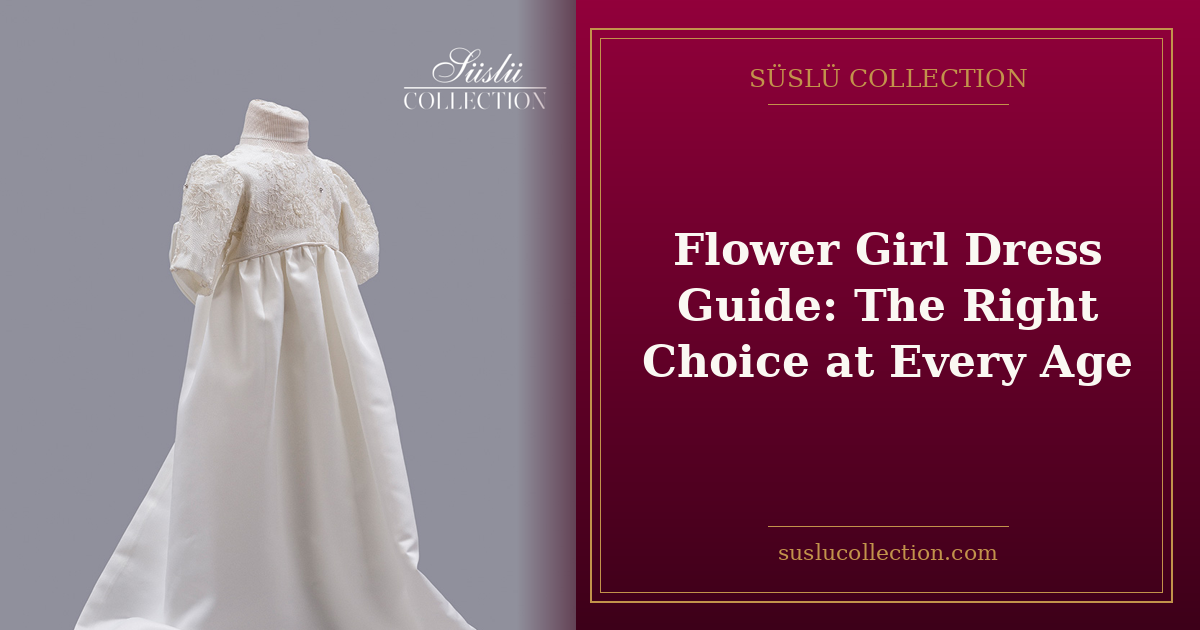
How do you choose the right flower girl dress? Short answer: five steps in order — age gate, colour question, layer skeleton, three measurements, day plan; comfort rules every one of them. 🌸
This guide walks the full path: styles by age, the never-compete-with-the-bride colour rule, fabric and layers, sizing, seasons, the ceremony day itself, accessories, where and when to buy, and the dress’s life after the wedding.
One promise up front: a well-chosen dress makes the child comfortable first and beautiful because of it — the order is the secret. ✨
Deep dives on every topic are linked throughout; start here, branch where you need detail.
The five-step path, explained
The strip drew the route; this section walks it. The logic is strict: each step narrows the next — age narrows style, colour narrows fabric, measurements narrow the order, the day plan protects it all. 🧭
Families who follow the order report the same thing: no late surprises, no wedding-morning improvisation.
Why does age come first?
Because a dress is cut for a body and a temperament: a two-year-old is carried, a five-year-old runs, an eleven-year-old notices everything — three different dresses. The full age map is in the styles-by-age guide.
What settles the colour so early?
One polite message to the bride: her concept is the constitution. Snow white with her blessing, ivory as the bridge, blush for full separation — the four-step protocol is in the colour guide.
What is the layer skeleton?
The dress inside the dress: soft lining against the skin, petticoat for shape, tulle layers for volume, top fabric for the camera — comfort is engineered in the order of those layers.
Why lock measurements so late?
Children grow toward the wedding, not toward today: three readings taken 2-3 weeks before delivery, plus a growth allowance, beat any early number — technique in the measuring guide.
The path is set. Now the age gate in detail. 🚪
The age gate: three doors, three dresses
The age gate is the guide’s central invention: 0-2, 3-6, 7-12 — three doors, each with its own silhouette, fabric weight and accessory dose. A dress that ignores the gate fights the child all day. 👧
The gate is about anatomy and temperament together: what the body needs and what the age enjoys.
What does the 0-2 door ask for?
Carried comfort: soft cotton lining, zero stiff volume, flat seams, an elasticated back — the baby lives in arms and on laps, so nothing may dig or scratch. One thin headband replaces the tiara.
What defines the 3-6 door?
Play-proof volume: this is the princess window — full skirts are loved and lived in, so the volume must pass the dance test: light tulle layers over a soft petticoat, never a wire hoop. The soft-circle rule keeps the shape without the cage.
What changes at 7-12?
The young-lady threshold: volume calms into an A-line, the waist finds a sash, the tiara thins to a delicate band — grace replaces puff, and the girl’s own opinion enters the fitting room with full voting rights.
What if a child sits between doors?
Temperament decides: a shy six-year-old may love the calmer 7-12 line, a bold eight-year-old may claim one more princess season — the gate guides, the child rules.
The gate is open. Next: the colour question. 🎨
Colour: the never-compete rule
Every colour decision answers to one referee: never compete with the bride. The rule is not aesthetics but courtesy — and courtesy resolves in a single message. 🕊️
The palette runs from snow white through ivory and champagne to blush and soft pastels: left to right, further from the bride.
When is white simply right?
With the bride’s blessing: many brides ask for their small white escort themselves — with that yes, snow white gives the most timeless frame in the album.
Why is ivory called the bridge?
It stays in the white family yet softly steps away from bridal white: the elegant answer to hesitation, and the natural friend of lace and warm skin tones.
What does blush solve?
The question itself: full separation means no permission needed — the child’s skin warms, the bride’s white gets a gentle backdrop in photos, and bridesmaid sets grade beautifully through the blush-champagne family.
How is the final tone confirmed?
By the daylight test: two fabric candidates beside the child’s face at a window, one photo — the camera votes where the eye forgives. Full protocol, wrist test included, in the colour guide.
Colour settled. Now the fabric beneath it. 🧵
Fabric, layers and the dance test
The list above is the guide’s quality gate: five moves, five minutes, zero regret — every dress, ready-made or custom, runs the dance test before the wedding. 💃
The test works because it checks the layer skeleton in motion, not on the hanger.
What makes volume child-safe?
The soft circle: shape from layered tulle and a gentle petticoat, never from wire — a soft-circle skirt collapses harmlessly onto a climbing, sitting, spinning child and springs back for the photo.
Which fabrics belong against the skin?
Breathing ones: cotton lining is the invisible hero — tulle stays outside, softness stays inside, and summer sweat is managed before it starts. The itch scan exists exactly for the places labels hide.
What is the half-layer option?
The 2026 favourite: a lightly petticoated A-line — volume’s silhouette at half the weight, beloved of the 5-7 band and of every child who plans to run. More in the volume guide.
Who runs the test?
The child, with the family watching the checklist: two spins, a sit, the itch scan, a stair walk — and the smile, which is the real signature. A child who beams has approved the dress; no adult opinion overrules it.
Quality gated. Next: numbers. 📏
Sizing: three centimetres beat every label
Sizing has one law: the age label finds the shelf, centimetres choose the dress — “5-6 years” is a factory average, your child is not. 📐
Three readings with a soft tape: height against the wall, chest at the widest point with one finger of ease, waist at the natural crease.
When are the readings taken?
2-3 weeks before delivery, in a calm moment, dated: children grow toward the wedding — an early number describes a smaller child. Growth allowance is added toward the ceremony date.
What if she sits between two sizes?
Go up, always: fullness is carried by a sash and a dart; tightness has no remedy on the day — the up rule is the cheapest insurance in the whole order.
Is skirt length a separate number?
Separate and non-negotiable: at walking age the hem ends at the ankle — zero stepping allowance — and it is confirmed on its own line, not inferred from the size. Full technique, special cases included, in the measuring guide.
Who confirms the size?
The atelier: send the three dated readings before ordering and get the named size back — the maker reads its own pattern better than any chart; confirmation is one message via contact.
Numbers locked. Now the calendar. 🗓️
Season and calendar: the backward count
Two clocks run behind every order: the season clock (what the weather asks of fabric) and the countdown clock (when to order what). Both are read backward from the wedding day. ⏪
The fixed star: box in hand one week early — every band is set from that point.
What does each season ask?
One sentence each: spring is tulle season with a thin bolero in the bag; summer wants cotton lining, short sleeves and a shade plan; autumn is layering craft; winter sends the coat to the door and dresses the scene in velvet touches — full wardrobe sentences in the season guide.
And the countdown bands?
Stock: order 2 weeks out. Made-to-order: brief 4-5 weeks out. Bridesmaid sets: 6-8 weeks. Measuring window: 2-3 weeks out. High season, holidays and out-of-town delivery each add days — the full backward count, calendar enemies included, is in the timing guide.
What does the one-week buffer buy?
Three things: the final try-on, the daylight photo, and room for any surprise — a buffer is material, not luck.
Ordering very early: safe or risky?
Split it: reserve the model early, measure late — stock certainty now, size certainty in the window. Two certainties, collected separately.
Clocks set. Now the day itself. 💒
Where to buy, and which lane
The table names the two honest lanes; the buying question underneath is single: where does certainty live? Tone certainty, size certainty, calendar certainty — the specialist atelier carries all three. 🛍️
Chains are seasonal, marketplaces are a photo lottery, fast fashion is single-day fabric: each serves someone, none serves a locked wedding date by default.
How is a trustworthy page recognised?
Seven checks: real daylight photos, a written fabric note, a centimetre chart with skirt length on its own line, a one-tone set line, written returns, real wedding photos from customers, and the answer test — one real question before buying. The full toolkit is in the buying guide.
When does made-to-order earn its weeks?
Three cases: woven-in name-and-date embroidery, unusual sizes, and bridesmaid sets cut in one tone by one hand — the six approval stations are in the custom guide; the stock-plus-embroidery middle path serves most families.
Can the lanes combine?
Elegantly: feel the tone in a shop, order size and set from the specialist — the hand’s certainty plus the calendar’s.
And our own door?
Open daily: the collection carries daylight photos, centimetre charts and one-tone sets; questions land at contact and return the same day.
Lanes chosen. Now the wedding morning. 🌅
The ceremony day: the threshold method
The day runs on one rule: arrive comfortable, dress at the venue — the gown’s duty begins at the threshold, not at home. The morning plays in five scenes. 🎬
Scenes: fed and rested at home in travel clothes; the dress rides in a garment bag; ten calm minutes in an arrival corner; gown on stage for ceremony and photos; play clothes for the party while the gown returns clean to its bag.
How does the threshold dressing work?
A quiet corner, hair first, then slip-dress-shoes-tiara in that order, one adult dressing while one distracts, and a final window-light photo catching collar, hem and tiara line — ten minutes, rehearsed once at home. Full choreography in the dressing guide.
What does the flower girl rehearse?
The walk and the basket: aisle tempo, the stop point, petal rhythm — once at home, once at the venue if possible; a familiar basket is a calm minute.
What sits in the ceremony bag?
Five access layers: tiara on top, gown in its bag, care kit, party clothes, and at the bottom the silent emergency kit — stain pen, mini sewing set, spare socks. One named adult owns the bag; the full packing order is in the accessories guide.
And if the venue is outdoors, by the water, on an island?
The texture decides the plan: wind pins for the Bosphorus, shade maps for gardens, ferry maths for islands — the city’s five venue textures are read child-first in the Istanbul venue guide.
The day is choreographed. One last chapter: afterwards. 📦
After the wedding: storage, second lives, meaning
A good dress outlives its first wedding: the last chapter covers the box, the routes and the story — because the guide’s economy is measured in years, not hours. 🌱
The first 48 hours decide everything: air the dress overnight, scan for stains in daylight, treat gently, dry fully, then box in acid-free paper.
How does long storage work?
The acid-free trio: box, paper, rolled folds — kept in living space, never basement damp or attic heat; five enemies and their defences are in the storage guide.
What are the second-life routes?
Four: the sister route, the cousin bridge, the stage route (recitals, balls, graduations) and the heirloom route — reverse measuring, the dart limit and the five-step handover ritual live in the reuse guide.
Where does the meaning come from?
From the oldest procession: children have walked wedding aisles as signs of blessing since antiquity — the history, the world’s variations and the royal frame are their own reads: why girls wear white, the history, world traditions, royal weddings — and the year’s direction in the 2026 trends guide.
Where does the path end today?
At one message: wedding date, the child’s age and your three readings to contact — a confirmed size and an honest calendar return the same day; the collection and the full range are open with daylight photos.
The path is complete: gate, colour, layers, numbers, calendar, lanes, day, afterlife. Summary below. 🎀
🧵 Notes from the Atelier
The message we receive most often after weddings is not about lace — it is “she was comfortable the whole day”: the comfort-first order proves itself in every album. Second note: families who run the dance test send us the spin videos, and the smile at the second turn has become our favourite quality certificate. Third: the one polite colour question to the bride keeps resolving in minutes what forums debate for weeks — courtesy is the fastest protocol we know.
📖 Quick Glossary
Age gate: the 0-2 / 3-6 / 7-12 style doors. Never-compete rule: the colour referee — the bride’s concept is constitution. Layer skeleton: lining + petticoat + tulle + top fabric. Soft circle: volume without wire. Dance test: spins, sit, itch scan, stairs, smile. Up rule: between sizes, choose the larger. Threshold method: dress at the venue, not at home.
⚡ Quick Summary
Five steps in order: age gate (0-2 carried, 3-6 play-proof, 7-12 graceful), colour by one polite question (white with blessing, ivory bridge, blush separation), layer skeleton with cotton against skin, three dated centimetre readings 2-3 weeks out with the up rule, and a day plan built on the threshold method. 🌸 Order stock 2 weeks out, custom 4-5, sets 6-8; box in hand one week early. After the wedding: 48-hour care, acid-free box, four second-life routes.
🎯 Next Step
Write the wedding date, the child’s age and your three readings to contact — confirmed size and honest calendar the same day; the collection is open with daylight photos and centimetre charts.
Sıkça Sorulan Sorular
How do I choose a flower girl dress?
Follow five steps in order: set the age gate (0-2 carried comfort, 3-6 play-proof volume, 7-12 young-lady grace), settle the colour with one polite question to the bride, check the layer skeleton for comfort, take three centimetre readings 2-3 weeks before delivery, and plan the day around dressing at the venue.
What colour should a flower girl wear?
The referee is the never-compete rule: snow white with the bride’s blessing, ivory as the bridge when in doubt, blush or champagne for full separation. Confirm the final tone with the daylight test — two fabrics beside the child’s face at a window, one photo.
When should a flower girl dress be ordered?
Counted backward from the wedding: stock dresses 2 weeks out, made-to-order 4-5 weeks, bridesmaid sets 6-8 weeks; measurements are taken 2-3 weeks before delivery and the box is in hand one week early. High season and holidays add days — write the date first and ask for an honest yes or no.
Kaynak: Wikipedia — Flower girl


