

Engagement Table Decoration: From Cloth to Candle Holder
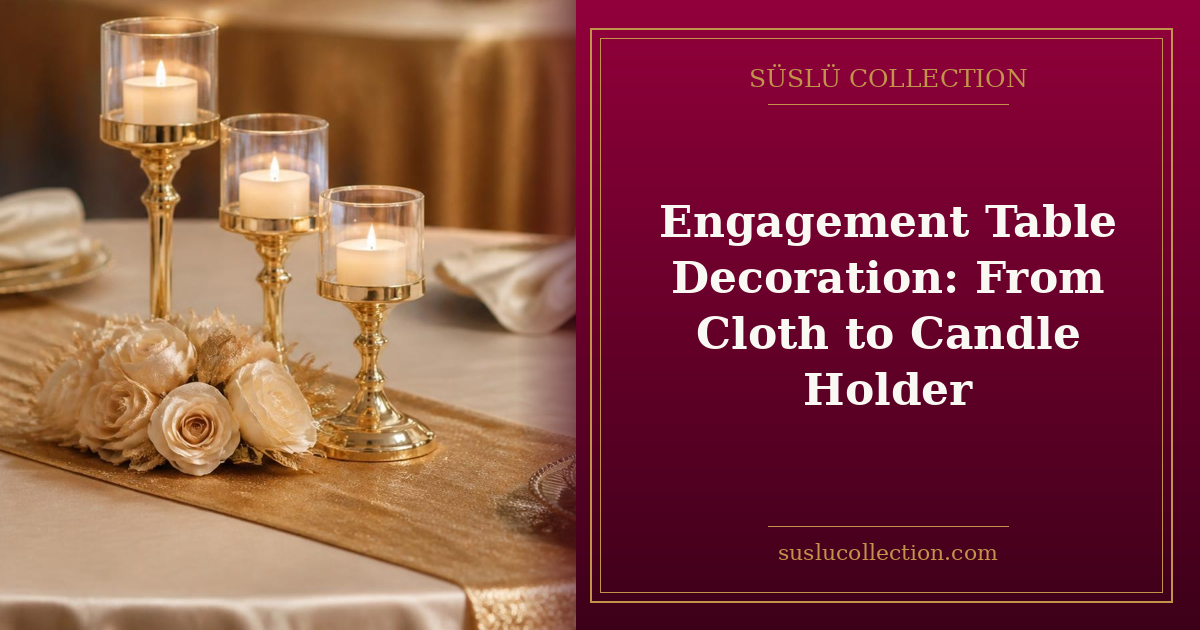
How do you decorate an engagement table? Short answer: in five layers — cloth, runner, candle holders, napkin rings and tulle-flowers; the colour trio is spread across these layers, and the ring table is kept the simplest and brightest. 🍽️
This piece covers the five layers, round versus rectangular tables, the order for dressing a table and how to choose materials.
A good engagement table invites guests to sit down: eye level clear, details repeating, light soft. ✨
Main guide: engagement party planning guide · products: organisation decorations.
Five layers: from cloth to tulle
The list set out the layers; this section opens each one’s job. The layers spread the colour trio across the table: main colour on the ground, supporting colour in the middle, metallic tone in the light. 🎨
Not every layer is needed; but their order never changes.
How is the cloth chosen?
In the trio’s main colour and sized to the table: falling to the floor on a round table, with even overhang on a rectangular one. Satin is elegant, linen natural, an embroidered lace cloth traditional.
What is the runner for?
A strip of cloth along the centre: it enriches colour and texture with a second layer and protects the main cloth from spills. On a round table it’s used as one strip or two crossing strips.
Why do candle holders matter?
They give light and height: two or three holders of different heights bring rhythm to a table. The metallic tone (gold, silver) carries the trio’s third colour. Outdoors, enclosed glass holders are preferred.
Why do napkin rings make a difference?
They are a small detail repeating at every place setting: when the same ring appears on every table, a sense of order forms. Glass, metal or fabric rings are chosen by concept.
Where do tulle and flowers go?
As the final layer: a fall of tulle at a table edge, a small group of fabric flowers at the centre. The centrepiece must not block eye level; guests should see each other.
The layers are done. Now the table shape. 📐
Round or rectangular?
The table compared the two shapes; this section explains how each is dressed. The shape changes the cut of the cloth and the centrepiece. 🔄
Most engagements use both: round tables for guests, rectangular ones for rings and refreshments.
What cloth suits a round table?
A round cloth falling to the floor gives the most elegant result; if a shorter cloth is used, a runner or a layer of tulle goes on top.
How is a runner laid on a round table?
One strip across the centre or two crossing strips, with ends hanging evenly. A round-table runner is the most economical layer for making a table look ceremonial fast.
What matters on a rectangular table?
A runner from end to end and candle holders at even intervals: rhythm keeps a long table from looking dull.
What shape should the ring table be?
Usually a small rectangular table or a console: it stands behind or beside the couple, visible from the front.
How many candle holders per table?
One central group of three on a round table for eight to ten guests; roughly one holder every metre and a half on a rectangular table. Measure keeps it from looking crowded.
How is the number of tables worked out?
Divide the guest count by eight and add one spare table: room for last-minute guests and a comfortable table for elders.
The shape is settled. Next, the order of dressing. 🛠️
The order for dressing a table
The strip gave the steps; this section explains each one’s trick. The rule: large to small, bottom to top — the cloth first, the light last. 🧰
One table takes ten minutes; dressing the first as a model and copying it speeds the rest.
How is the cloth laid?
Ironed and symmetrical: its centre line matches the table’s, the overhangs are even. In a garden or on a windy terrace it’s clipped underneath.
How does the runner sit?
From the centre with both ends hanging evenly; on a round table with crossing strips, the first strip goes down before the second. No creases should remain.
How is the central group built?
Candle holders and flowers of different heights, but never high enough to hide the face of the guest opposite: check it sitting down.
How is the service set?
The same everywhere: plate, napkin in its ring on top, glass on the right. One correct table is the model for all the rest.
Why is the final check done seated?
Guests see the table sitting, not standing: at eye level you notice if a flame, a flower or a piece of tulle is in the way.
The order is done. Last section: materials. 🛍️
Choosing materials and care
Engagement table materials are bought once and used many times: they serve again at the henna night, the wedding and festive tables. This section covers choosing them well. 🧵
A good product becomes economical when it’s reused.
How is the cloth fabric chosen?
Satin is elegant and glossy, linen natural and matte, an embroidered lace cloth traditional and handmade in feel: stain-resistant, easy-to-iron fabrics add practicality.
Glass or metal candle holders?
Glass holders are light and suit every concept; metal holders (gold, silver) carry the trio’s metallic tone. Outdoors, enclosed glass that shields the flame is essential.
Which napkin rings?
Glass rings are elegant and modern, metal ones classic, fabric or ribbon ones romantic: they’re counted per guest, not per table.
How is tulle used?
As a light fall or a backdrop: decorative tulle creates a ceremonial feel with very little material; outdoors it must always be secured.
Care after the ceremony?
Cloths and runners are treated for stains and washed at once, candle holders cleaned and wrapped in paper: they wait ready for the henna night and the wedding.
Where do the materials come from?
Cloths, runners, candle holders, napkin rings and tulle are in organisation decorations, and can also be seen in our Bakırköy and Fatih stores. Details in the supplies piece.
The table file closes: layers, shape, order, materials. Summary below. 🎀
🧵 Notes from the Atelier
The first product we usually suggest for an engagement table is a runner: a single strip makes even a plain cloth look ceremonial. Second note: families who dress one table as a model and copy it build tidier tables in half the time. Third note: glass napkin rings have become the most-asked detail of recent years; they’re light and suit every concept.
📖 Quick Glossary
Runner: a strip of cloth along the centre of a table. Central group: the arrangement of candles and flowers at a table’s centre. Napkin ring: the ring that holds a napkin. Eye level: the seated guest’s line of sight; the centrepiece mustn’t block it.
⚡ Quick Summary
An engagement table is dressed in five layers: cloth, runner, candle holders, napkin rings, tulle and flowers. 🍽️ On a round table, a floor-length cloth and one central group; on a rectangular one, an end-to-end runner and rhythmic candle holders. Order: cloth, runner, central group, service, light — with a final check made seated. Good materials are reused at the henna night and the wedding.
🎯 Next Step
Write your table count and colour trio via contact — a material list the same day; products in organisation decorations.
Sıkça Sorulan Sorular
How do you decorate an engagement table?
In five layers: a cloth in the trio’s main colour, a runner along the centre, candle holders of different heights, the same napkin ring at every place, and tulle and fabric flowers as a final touch. The ring table is kept the simplest and brightest.
How is a runner laid on a round table?
As one strip across the centre or two crossing strips, with the ends hanging evenly. Laid over a short round cloth, a runner makes the table look ceremonial immediately.
How many candle holders should an engagement table have?
A central group of three on a round table for eight to ten guests, and roughly one holder every metre and a half on a rectangular table. They must not block the face of the guest opposite.
Kaynak: Wikipedia — Tablecloth
Engagement Party
Browse Products


