

How to Measure a Christening Gown Size: Three Numbers That Fit

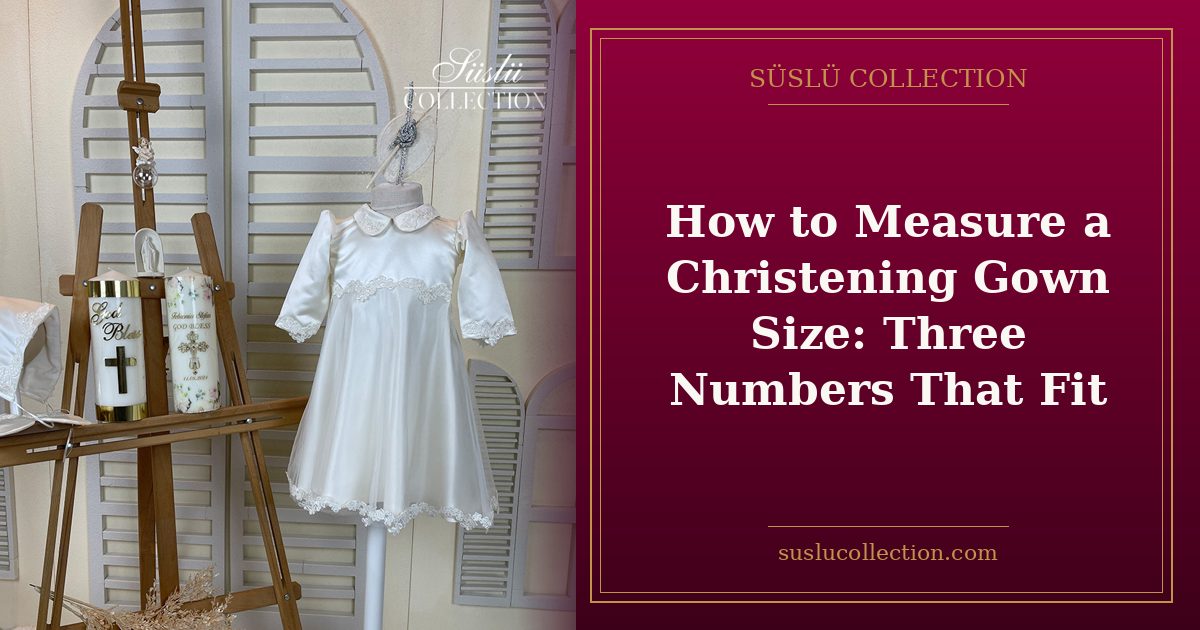
How do you measure a baby for a christening gown? The short answer: three centimetres beat every month label — length, chest and head, taken in a calm moment, dated, and confirmed before ordering. 📏
This guide walks the five measuring moves, exposes the month-label trap, and locks in the five rules that prevent nearly every exchange.
The stakes are simple: sizing is the difference between a fitting and a re-ordering — ten minutes with a tape saves ten days of cargo. ✨
Master guide: the christening outfit guide · timeline context: when to prepare.
Five moves with a soft tape
The strip shows the sequence; this section adds the craft. Measuring a baby is a two-person, two-minute job — one soothes and steadies, one reads the tape. 🤱
Tool note first: a soft tailor’s tape, never a rigid ruler; over a thin undershirt, never over thick clothes.
Why does the moment matter?
Because a wriggling baby adds phantom centimetres: the post-nap, pre-feed window gives the calm minute the tape needs. Failing that, measure during deep sleep.
How is length taken accurately?
Baby lying flat, legs gently straightened once, tape from crown to heel along the body line. One gentle straightening — never force a stretch.
Where exactly does the chest tape sit?
Around the widest ribcage line, snug plus one finger of ease: that finger is breathing room, not sloppiness.
What does the head number buy?
The bonnet fit: above ears and brows, the tape’s largest circle. A bonnet sized by guess is the set’s most common misfit — set logic in the accessories guide.
Numbers taken. Now the trap they replace: the month label. ⚠️
The month-label trap
The table names the trap; this section explains why it catches so many careful parents. Month labels feel authoritative — printed, standardised-looking — yet they describe a factory average that no single baby is. 🪤
The trap snaps hardest at christenings because the timeline is fixed: a mislabeled everyday romper waits in the drawer, a mislabeled gown misses the ceremony.
How far apart can brands drift?
A full size or more: one maker’s “6-9 m” matches another’s “9-12 m”. Centimetre tables are the only common language across brands and models.
What do growth spurts do to labels?
Outrun them: a spurt between ordering and ceremony turns “fits now” into “fit last month”. The cure is measuring close to delivery — rule one below.
Are labels useless, then?
They are shelf shortcuts, not fitting tools: use them to find the shelf, use centimetres to choose the size. Product cards in the collection carry both for exactly this reason.
What about gown length labels?
Separate number, separate check: a “size 68” gown may carry an 85 cm hem. Body size fits the baby; hem length serves the album — the waterfall maths is in why gowns are long.
Trap disarmed. Now the five rules that finish the job. 📐
Five rules, ninety percent fewer exchanges
The list states the rules; this section defends the two that surprise people most — the timing rule and the go-up rule. Together they erase the two classic exchange stories. 🛡️
The remaining rules are administrative but mighty: separate hem check, dated notes, confirmation before ordering.
Why measure only 2-3 weeks before delivery?
Because babies grow toward the ceremony, not toward today: early numbers describe a smaller baby. The countdown that places this window is in the timeline guide.
How much growth allowance is added?
A modest forward pay per remaining week, scaled by age — younger babies grow faster. Send us the date and numbers via contact; we calculate the allowance for your exact gap.
Why does “between sizes, go up” always hold?
Fabric physics: a gown wears room gracefully — a tuck, a sash, a flowing line — but tightness has no cure on the day. Up is insurance; down is a gamble.
What does confirmation actually change?
It converts your three numbers into a named size on a real product: the workshop reads its own cut better than any chart. One message, one confirmed size, zero midnight guessing.
Rules locked. One last chapter: special cases. 🔍
Special cases: hybrids, heirlooms, two babies
Standard sizing covers most orders; three cases bend the rules and deserve their own paragraphs. Each resolves with one extra number or one extra step. 🧩
The pattern across all three: complexity is handled before ordering, never at the font.
How do hybrid and romper models size?
Like rompers: body length matters more, and snap placement adds a crotch measurement on some cuts. Model differences are mapped in the model guide; each card lists its own scheme.
How is an heirloom gown fitted to a new baby?
In reverse: the gown’s measurements exist, the baby is measured against them, and the tailoring margin decides. Loose Victorian cuts usually pass untouched — the handover ritual is in the reuse guide.
What if twins are christened together?
Two full measurement sets, no sharing: twins can differ by a size. Matching models with individual sizes photograph beautifully and fit honestly.
And if the numbers still feel uncertain?
Send a phone photo of the tape in place with your numbers to contact: we spot technique slips in seconds. Certainty is a two-message conversation — then the collection awaits with centimetre tables open.
The sizing file closes: five moves, one trap, five rules, three cases. Summary below. 🎀
🧵 Notes from the Workshop
Our exchange log tells one story on repeat: measurements taken months early, ceremony baby one size bigger — the 2-3 week window would have erased every case. Second note: the tape-photo trick catches the same slip weekly — the chest tape riding too low; one glance, one correction. Third: families who send three numbers for confirmation re-order for the next child without a single question — confirmed sizing is a skill families keep.
📖 Quick Glossary
Calm window: post-nap, pre-feed measuring moment. Growth allowance: forward centimetres added toward the ceremony date. Month-label trap: trusting factory averages over measurements. Hem length: the gown’s separate skirt measurement. Go-up rule: choosing the larger of two candidate sizes.
⚡ Quick Summary
Sizing runs on three centimetres — length (crown to heel, lying flat), chest (widest line plus one finger), head (above ears and brows) — taken in a calm moment with a soft tape and dated. 📏 Month labels are shelf shortcuts, not fitting tools: brands drift a full size apart. Five rules finish the job: measure 2-3 weeks before delivery, add growth allowance, go up between sizes, check hem length separately, confirm before ordering.
🎯 Next Step
Take the three numbers tonight and send them with your ceremony date via contact — confirmed size the same day; centimetre tables are open on every card in the collection.
Sıkça Sorulan Sorular
How do you measure a baby for a christening gown?
Three numbers with a soft tape in a calm moment: length from crown to heel lying flat, chest around the widest ribcage line plus one finger of ease, and head circumference above the ears and brows. Date the numbers and confirm them with the seller before ordering.
Are month sizes reliable for christening outfits?
No — month labels are factory averages and brands drift a full size apart. Use labels to find the shelf and centimetres to choose the size; measure 2-3 weeks before delivery and add growth allowance toward the ceremony date.
What if the baby is between two sizes?
Go up: a gown wears extra room gracefully with a tuck or sash, but tightness has no fix on the day. The go-up rule is the cheapest insurance in christening shopping.
Kaynak: Wikipedia — Anthropometry


