

Turkish Engagement Traditions: Meaning and Symbols
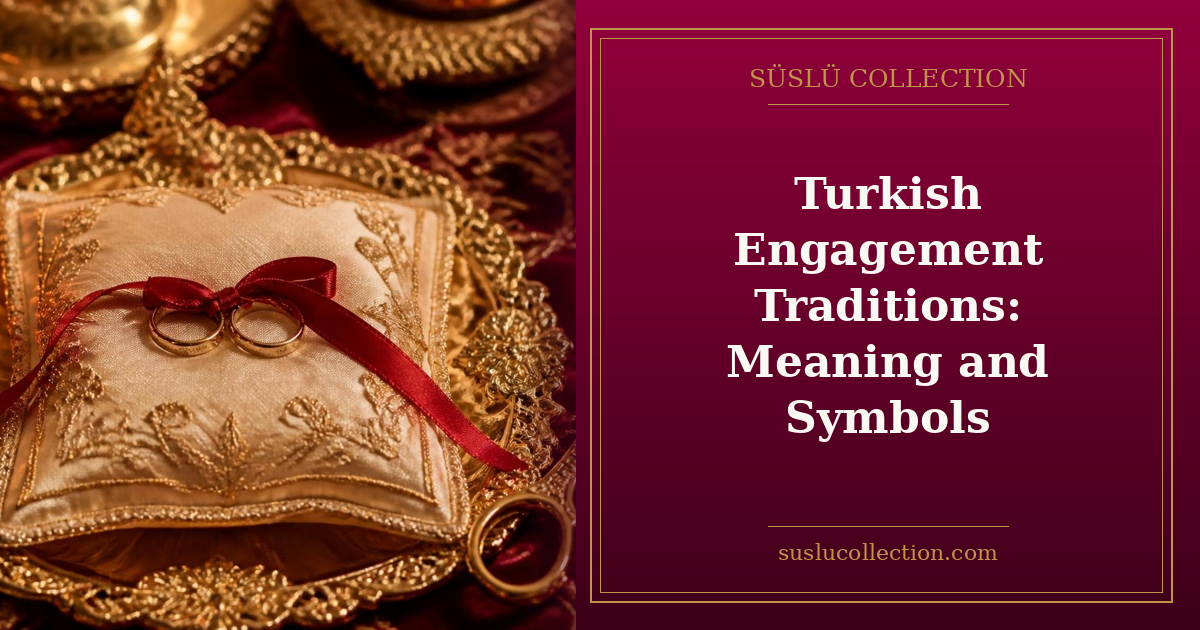
What are Turkish engagement traditions? Short answer: two steps on the road to marriage — the söz is the first formal promise the families give after the bride is asked for, and the nişan announces that decision with rings. A red ribbon, the rings and sherbet are this tradition’s symbols. 💍
This piece covers the traditional road to marriage, the language of söz and nişan, and the symbols of the engagement ceremony.
Tradition is not a list of rules but a chain of meaning: a little different in every family, yet always the same at heart — joining two families. ✨
Main guide: engagement party planning guide · the bundle tradition: from bundle to keepsake box.
The road to marriage: five steps
The strip set out the steps; this section opens each one’s meaning. The logic of tradition is gradual closeness: two families are bound to each other step by step. 🪜
Today some steps are merged or simplified, but most families keep the order.
Why is meeting the first step?
A marriage joins two families as much as two people: the families knowing each other lets the later steps be taken with confidence.
How is the bride asked for?
The groom’s family, usually with an elder, comes to the bride’s home with flowers and chocolate; coffee is served and the elder speaks the family’s intention.
When is the söz given?
When the answer is positive: the same evening in some families, a few weeks later at a separate gathering in others. Promise rings may be exchanged, or the promise given alone.
What does the nişan add?
The announcement: relatives and close friends are invited and the rings are put on ceremonially. Planning detail is in the main guide.
Henna and wedding?
The henna night is the emotional ceremony of seeing the bride off from her family home; the wedding and the marriage itself are the road’s final step.
Can the steps be merged?
Yes: in many families today the asking and the söz happen on one evening, and the nişan and henna in one week. What matters is keeping the small gesture that carries each step’s meaning: a flower, a ring, a prayer.
The road is drawn. Now the language. 🗣️
The language of söz and nişan
The table set the two ceremonies side by side; this section describes their spirit. A söz looks inward, a nişan outward: one happens between families, the other before the wider circle. 🤝
That difference also sets the scale of the decoration.
What is the spirit of a söz?
Sincerity and intention: the families sit and talk, sherbet is served in many homes and prayers are said. Warmth matters more than display.
What is the spirit of a nişan?
Celebration and announcement: guests, music, refreshments and the ring ceremony. It makes the couple known as engaged from that day on.
Are there regional differences?
Many: in some regions söz and nişan are merged, in others a nişan is as large as a wedding; catering, dress and gift customs also vary.
What has changed today?
Ceremonies are getting simpler and more personal: garden engagements, small söz gatherings and the couple’s own touches are coming forward. Trends are in the 2026 trends piece.
Who hosts?
Traditionally the ceremony is held at the bride’s home and her family hosts; today many families share the costs and the tasks.
The language is clear. Next, the symbols. 🎀
Symbols of the engagement ceremony
The list set out the symbols; this section opens each one’s meaning. Symbols tell the ceremony’s story: a guest understands what is happening without a word being said. 💫
Knowing the symbols also makes the decoration meaningful.
What does the red ribbon stand for?
It ties the two rings together: two lives joining. Its red is associated with love and abundance, which is why it can sit outside the colour trio.
Who cuts the ribbon?
Usually one of the family elders: the cut means the family’s blessing and good wishes. A short speech or prayer often comes first.
On which hand is the ring worn?
In the common Turkish custom the engagement ring is worn on the right hand and moved to the left at the wedding. This can vary from family to family.
Why sherbet and sweets?
With the wish “let us eat sweetly and speak sweetly”: the sweet offering expresses a hope that the bond between the families stays sweet.
What is the engagement bohça?
The gifts and fabrics the groom’s family prepares for the bride: presented in a carefully made bundle or keepsake box. Box options are in the keepsake box styles piece.
Which colours are traditional?
Red in the ribbon, gold and burgundy in the bundle and tray: tones linked with abundance and celebration. The rest of the decoration follows the couple’s own trio freely.
The symbols are covered. Last section: carrying tradition into today. 🌿
Carrying tradition into today
Tradition is living, not fixed: every generation remakes it a little. This section gives ways of carrying it into a modern ceremony. 🌱
The essence stays, the form flexes.
Which elements are always kept?
In most families the rings, the ribbon, an elder’s speech and a sweet offering: the four elements that carry the ceremony’s meaning.
What can flex?
Venue, crowd, music and decoration: a small söz at home and a large nişan in a garden carry the same tradition.
How do you balance elders’ expectations?
Keeping the symbols is usually enough: the ring ceremony is done traditionally while the decoration and venue reflect the couple’s taste.
Can family heirlooms be used?
It is very meaningful: a cloth from a grandmother laid on the ring table, an old tray carrying the rings — two generations meet in one ceremony.
Where to begin?
Write your ceremony type and the traditions you want to keep via contact — a decoration proposal the same day; products in organisation decorations.
The tradition file closes: road, language, symbols, today. Summary below. 🎀
🧵 Notes from the Atelier
The engagement ribbon and scissors are the products we’re most often asked “which is the right one?” about: for most families the answer is a red ribbon and a simple, decorative pair of scissors. Second note: families who lay a grandmother’s cloth on the ring table live the ceremony’s most emotional moment at that table. Third note: families who prepare a bohça say that presenting the gifts in a proper keepsake box turns the bundle into a lasting memory.
📖 Quick Glossary
Asking for the bride: the groom’s family visiting to state the intention to marry. Söz: the first formal promise between two families. Engagement ribbon: the red ribbon tying the two rings. Bohça: the gifts and fabrics prepared for the bride’s side.
⚡ Quick Summary
The traditional road: meeting, asking for the bride, söz, nişan, henna and wedding. 💍 A söz is the families’ intimate agreement, a nişan the announcement. Its symbols: the red ribbon, the elder who cuts it, the ring on the right hand, sherbet and sweets, and the bohça. Today the essence stays and the form flexes: rings, ribbon, a speech and sweets remain constant in most families.
🎯 Next Step
Write the traditions you want to keep via contact — a proposal the same day; products in organisation decorations.
Sıkça Sorulan Sorular
What are Turkish engagement traditions?
They are two steps on the road to marriage: the söz is the first formal promise between two families after the bride is asked for, and the nişan is the ceremony announcing that decision with rings. The red ribbon, the rings, an elder’s speech and a sweet offering are its symbols.
Who cuts the ribbon at an engagement?
Usually one of the family elders; the cut expresses the family’s blessing and good wishes, and is often preceded by a short speech or prayer.
On which hand is a Turkish engagement ring worn?
In the common Turkish custom it is worn on the right hand and moved to the left hand at the wedding. The practice can vary between families and regions.
Kaynak: Wikipedia — Engagement
Engagement Party
Browse Products


