

Bridal Hats by Face Shape: The 60-Second Test and Cheat Sheet

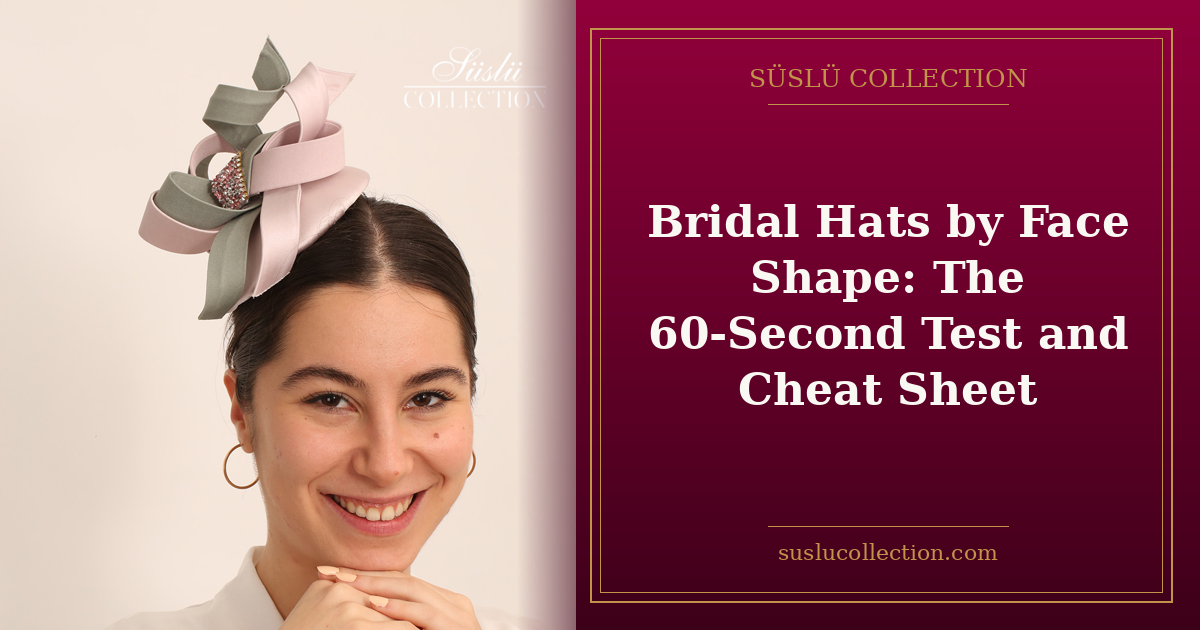
The same headpiece crowns one friend and swallows another — why? The answer is never the hat; it is the geometry underneath. 📐
Face shape is the quiet variable of millinery: mounting angle, base size and netting density all reply to your outline.
This guide finds your shape in sixty seconds, hands you the cheat sheet, and turns “does it suit me?” into a solved equation before you ever reach the basket. ✨
Main guide: the wedding hat guide · style names: which is which.
First, name your shape — the 60-second test
Most shoppers skip this step and pay for it in returns. The mirror test above takes one minute and guides every future purchase. ⏱️
Two measurements decide everything: the widest point of the face and the chin line. Everything else is refinement.
Where is your widest point?
Brow-wide reads heart; cheek-wide reads round or diamond; jaw-wide reads square; even all the way down reads oval or long.
What does the chin line add?
A soft, curved chin pairs with round and oval; a squared chin confirms the angular family. Pointed chins push heart and diamond readings.
What if two shapes both fit?
Normal — most faces are blends. Take the dominant reading and treat the second as a styling footnote, not a contradiction.
Does hairstyle change the result?
It changes the frame, not the face: test with hair fully pulled back, then let the wedding hairstyle adjust the final choice with the hairstyle guide.
Shape named and noted. Now the payoff: the cheat sheet, decoded. 🗝️
The cheat sheet, decoded shape by shape
The list above is your pocket answer; this chapter explains why each rule works — because understood rules survive real shopping. 🧠
One mechanism drives everything: a headpiece either repeats your outline or counters it. Suiting means countering gently.
Why does everything suit oval?
Oval is millinery’s neutral canvas: no line to counter. Owners of oval faces choose by occasion and outfit — the freedom is real, use it.
Why does the pillbox rescue round faces?
Its upright walls add vertical centimetres exactly where roundness lacks them. Wide flat discs do the opposite, repeating the circle — that is the one purchase to skip.
What softens square and diamond faces?
Curves against angles: rounded bases, draped netting and dotted French veiling blur straight jawlines beautifully. Sharp geometric brims would double the angularity.
How do heart and long faces balance?
Heart faces calm a wide brow with mid-size discs at eye line; long faces break the vertical with side-mounted pieces and gentle brims. Both fixes live in the mounting angle — next chapter’s subject.
Rules understood. Now the fine-tuning dial every shape shares: the mounting angle. 🎛️
The mounting angle: millinery’s secret dial
Two identical headpieces, two different faces in photos — the difference is often just where the piece sits. The table above holds the two base angles. 🧭
Angle is free to change at fitting time, which makes it the cheapest correction in the whole process.
What does top-centre mounting do?
It stacks height on the crown: round and heart faces gain the vertical line they lack. Symmetry also reads formal — the church and registry favourite.
What does side mounting do?
It draws a diagonal across the head: long faces gain width, square faces gain softening asymmetry. The posture reads relaxed and editorial.
How far to the side is right?
The classic anchor is above the outer edge of the eyebrow. Beyond the ear reads costume; short of the temple reads accidental.
Can the angle be tested before buying?
Yes — hold any clip or brooch at both anchors in the mirror; your face votes within seconds. Ready pieces in the collection list their mounting type on every product card.
Dial mastered. Last stop: netting density and base size — proportion. ⚖️
Proportion: netting density and base size
Shape says the style, angle says the position; proportion says how much. The rule fits one line: the piece scales to the face, never to the dress. 📏
Two sliders remain: how dense the netting, how large the base. Both follow your outline’s strength of line.
Who carries dense netting?
Strong features and larger faces: dense French net gives them a worthy frame. Fine features under heavy net disappear — they ask for open, airy weaves.
Who carries large bases?
Broader shoulders and taller frames balance them naturally; petite frames shine with small and mid bases. Photograph yourself at three steps’ distance — the camera settles all debates.
Do glasses change the math?
They add a frame inside the frame: choose eye-level or shorter netting so the two frames never fight. Brow-level netting plus glasses is the cleanest pairing.
Where to go from here?
With shape, angle and proportion noted, browse the veil collection — or send a bare-hairline selfie via contact; we return a shape reading and two style picks, usually the same day.
Equation solved. The atelier notes and summary close the file. 🎀
🧵 Notes from the Atelier
The sentence we correct most gently: “hats don’t suit me.” In our fittings it has never once survived the mounting-angle test — the customer had only ever tried one angle. Second note: round-faced brides fear the pillbox by instinct and love it on sight; vertical walls do quiet magic. Third: send the shape selfie without makeup contouring — shading tricks the reading, and the hat will meet your real outline on the day.
📖 Quick Glossary
Mounting angle: where the piece anchors — top-centre or side. Base: the structured body the netting rises from. French net: wide-gauge veiling, often dotted. Anchor point: the classic side position above the brow’s outer edge. Proportion: the piece’s size relative to the face.
⚡ Quick Summary
Suiting is geometry: name your shape with the 60-second mirror test, then counter your outline gently. 📐 Oval wears all; round gains height from a pillbox; square and diamond soften under curved, dotted net; heart balances with mid discs; long breaks the line with side mounting. Fine-tune with the mounting dial and scale the piece to the face. Glasses pair best with brow-level netting.
🎯 Next Step
Turn your one-word shape into two shortlisted pieces: browse the collection with the cheat sheet open, or send a selfie via contact for a same-day shape reading.
Sıkça Sorulan Sorular
Which bridal hat suits a round face?
An upright pillbox or any style with vertical build: the added height counters the circle. Wide, flat discs repeat the roundness and are the one style to skip.
How do I find my face shape for a hat?
Pull the hair fully back, trace your reflection’s outline on the mirror, then read the widest point and chin line. The whole test takes a minute.
Can I wear a birdcage veil with glasses?
Yes — choose brow-level or eye-level netting so the veil and the glasses frames never overlap. Open, airy weaves work better than dense net.


